Photon · Draft posts
156First batch of drafts for @danieltian. Each section is a post type; each heading is the angle, with the posts written for it underneath.
Growth
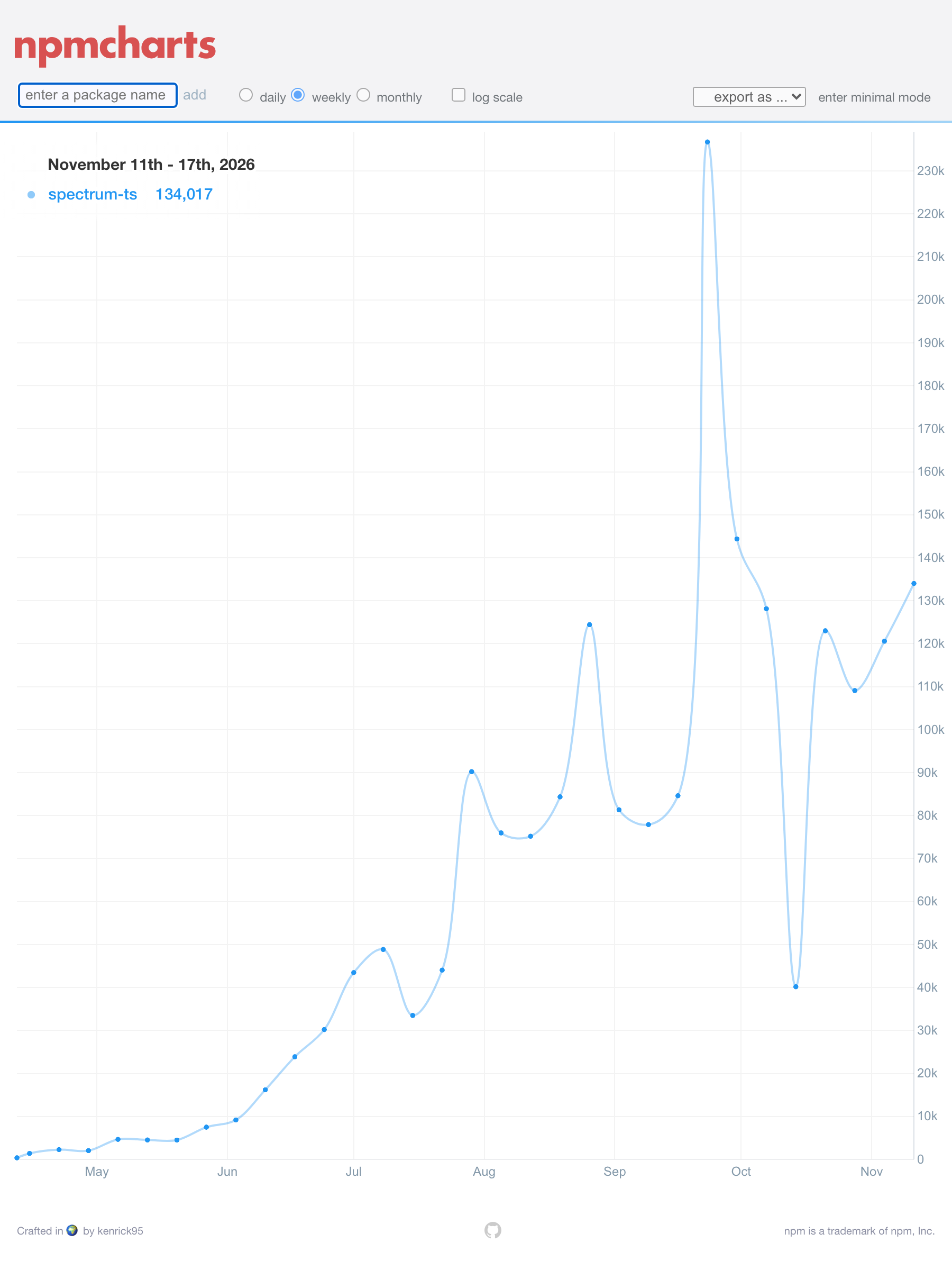
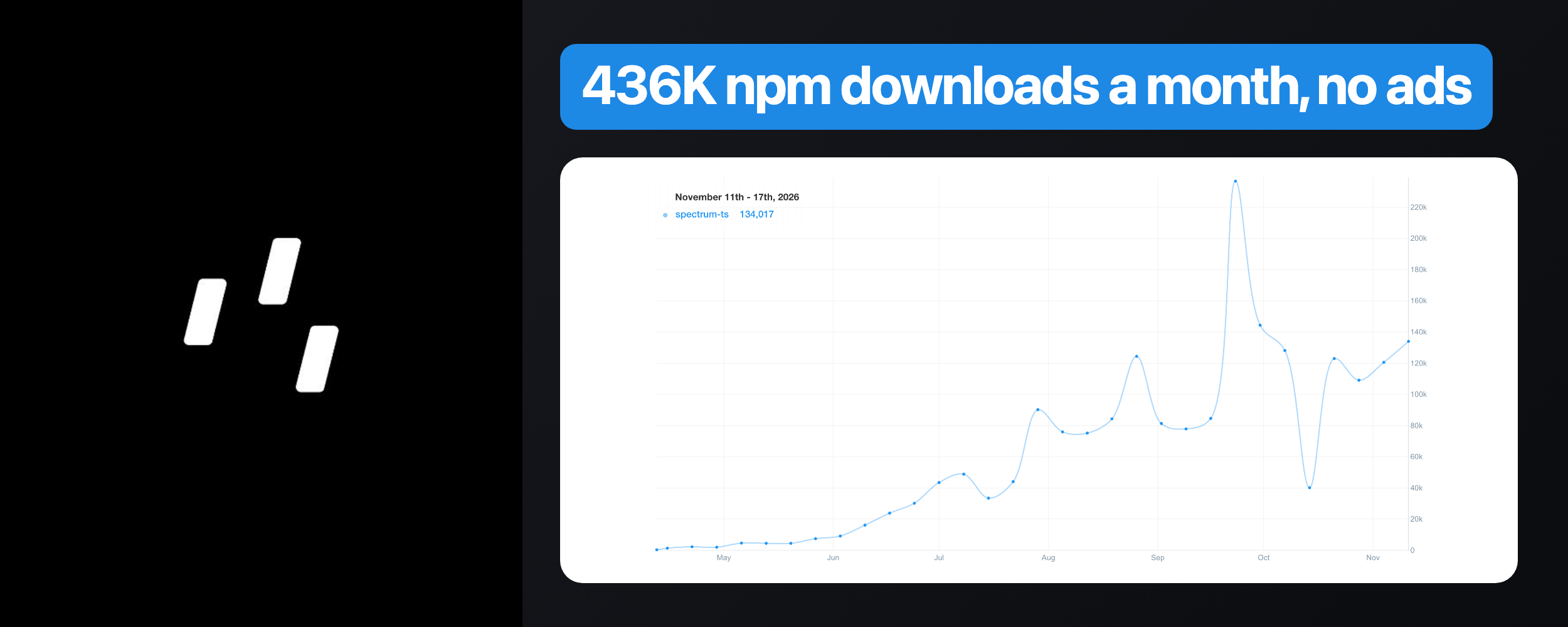
49 posts436K npm downloads
The flagship growth story: how spectrum-ts got to 436K npm downloads a month in 7 months, and the levers behind it.

our open source SDK was downloaded 436,095 times last month
we spent $0 on ads to get there
in april it had less than 1000 downloads and 0 partnerships. everyone gave us the same advice: run paid ads and secure your SEO
we did neither
we open sourced everything and charged nothing for about six months. ppl had to touch it before they could want it
then we removed the sales call. on Photon you click and use it for free
and we got built into the agent frameworks developers already run, so ppl install us without ever visiting our site
97 releases later the number is still moving
if you are growing a developer tool: make it free to touch and remove every step between ppl and the code
how our SDK got to 436,095 downloads a month with no ads:
- we gave it away for six months before charging anyone
- we deleted the sales call. click and use it for free
- we got built into tools developers already run
- we shipped 97 releases since april
more than half of our users now come from word of mouth
we started at less than 1000 downloads and 0 partnerships, so none of this needs a big team
it needs a product ppl can try in a few minutes. that is the whole idea behind how we grow @photonhq
every piece of growth advice i got for Photon was about ads and SEO
we ignored all of it and bet on one idea: put the product in front of developers and let them use it for free
in april our SDK had less than 1000 downloads. last month it had 436,095
developers do not respond to ads. they respond to trying the thing
 daniel_t·Article
most advice about growing a developer tool comes down to two things: run paid ads and fix your SEO. we did neither, and our SDK was downloaded 436,095 times on npm in the 30 days to november 11
i'm Daniel, the co-founder of Photon. we give AI agents a phone number, so ppl can text an agent in iMessage and other messaging apps the same way they text a friend. the SDK that developers install to do that is called spectrum-ts. it is open source, and the first release was april 14 of this year
i want to be straight about the number before i explain it. npm counts every install, and that includes automated build systems and bots. every npm number you have ever seen works that way. what i care about is the direction: in april we had less than 1000 downloads and 0 partnerships, and seven months later we are here
tldr: we made the product free to touch, we removed every step between a developer and the code, and we got built into tools ppl already use. the rest of this article is how each of those happened and what i would not rely on
1. we gave it away for 6 months before we charged anyone
Photon did not start with a pricing page. we open sourced our iMessage integration in october 2025, and from october to march there was nothing to buy. i call that period our open source era
it was not a growth strategy at the time. the truth is that most developers did not know an AI agent could live inside iMessage at all, so there was nothing to sell yet. you cannot charge for a category ppl have not seen. they had to install it, break it, and see a blue bubble come back from their own code
so for six months our whole job was educating the market. developers found the repo, tried it, and told other developers. some of them sent fixes. by the time we launched a managed product in april, there were already ppl who understood what it was and wanted us to run it for them
2. we removed the sales call
most tools in our space make you book a demo call before you get access. i understand why. a call lets you qualify the lead and control the story
we removed all of that. you click and you use it for free
the reason is who we sell to. the hardest deal in B2B is selling to a CTO. developers are talented, curious and very opinionated, and they do not believe a slide deck. they want to read the docs and run the thing themselves, usually late at night when no sales team is awake. if the product is good, the best thing i can do is stay out of the way
this is the decision i would defend the hardest. more than half of our users now come in through word of mouth, and i do not think a developer recommends a tool to a friend if the first step is "book a call with their team"
3. we got built into the tools ppl already run
the single best thing that happened to our downloads was not a launch of ours
there is a popular open source AI agent called Hermes Agent. a lot of developers run it as their personal assistant, and many of them wanted to text it from iMessage. Hermes now ships Photon as its iMessage option, which means every person who sets that up installs our SDK without ever visiting our website
we made a one minute clip showing the setup, and it did 137K views on X. we did not pay for any of them. ppl shared it because it solved something they already wanted to do
the lesson i took is that a developer tool grows fastest when it is a step inside someone else's workflow. we stopped asking developers to come to Photon and went to where they already were. we have done the same with other agent frameworks since, and each one works the same way: their users become our users on the day they need messaging
4. we shipped all the time
we have put out 97 releases of the SDK since april. that is roughly one every two or three days
i used to think of releases as engineering work, separate from growth. they are the same thing. when a developer lands on a repo, the first thing they check is whether it is alive. a project that shipped yesterday feels safe to build on. a project that last shipped four months ago feels like a risk, however good the code is
shipping often also meant that when someone reported a problem, the fix was usually out within days. developers remember that, and they say it out loud to other developers
5. we spent on one video instead of ads
when it was time to launch our iMessage App API, every launch video agency pitched us the same template. i said NO to all of them, and we worked with a music video and film team instead
we got 1.67M views on that launch video. for a piece of messaging infrastructure, that is a lot of ppl watching the product do one thing they can picture, with a link they could try the same day
i would rather make one thing ppl choose to watch than buy a month of impressions they scroll past
what i would not rely on
i do not want this to read like everything worked
our Hacker News post got 33 points. that is fine, and it did not change our trajectory. i would not plan a launch around it
stars are the same. the repo has 2,201 of them and i like seeing the number go up, but stars follow usage. chasing them directly does nothing
and none of this works if the first ten minutes with the product are bad. free and open only help if the thing runs when a stranger tries it. most of our real work went there, not into marketing
what i would do again
if i were starting a developer tool tomorrow, i would do the same four things in the same order
make it free to touch, so ppl can understand the category before you ask for money. remove the call, so the product does the selling. find the tool your users already live in and become a step inside it. and ship so often that the project always looks alive
we are only valuable if ppl are using us. we should not even exist if no one is touching our code base, so every decision we made was about getting more ppl to touch it
if you are building an agent and want it to live where your users already text, the SDK is open source and free to try
0 to 2,200 GitHub stars
What moved GitHub stars and what did nothing. Honest list beats a brag.
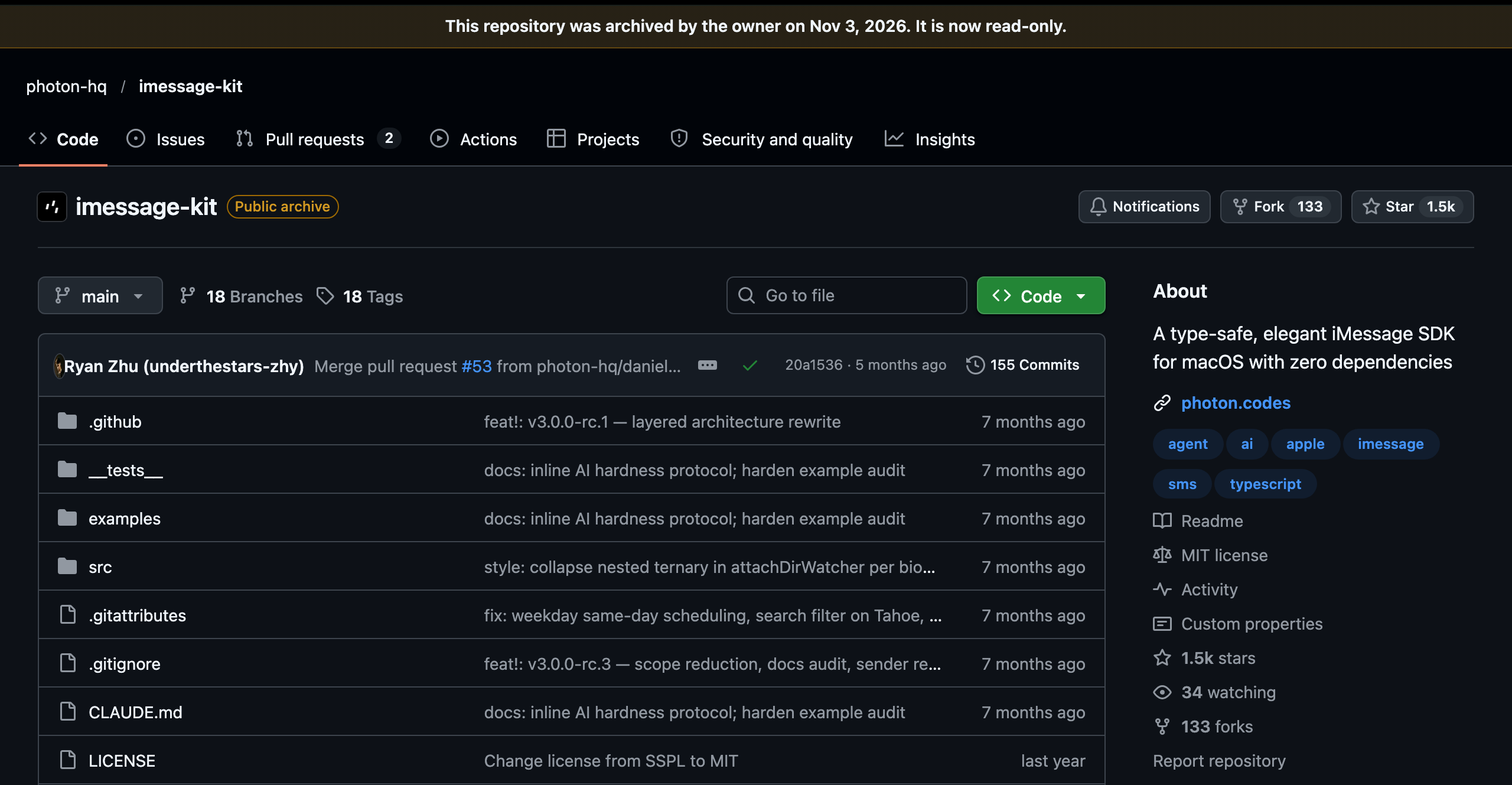
we archived a github repo with 1,479 stars and started again from 0
it was the only proof we had
that first repo was a small kit for connecting an AI agent to iMessage. it is why anyone noticed us
but developers wanted one SDK that worked across messaging apps, and keeping the old kit alive would have split our attention
so we rebuilt it as the SDK behind Photon and let the star count reset
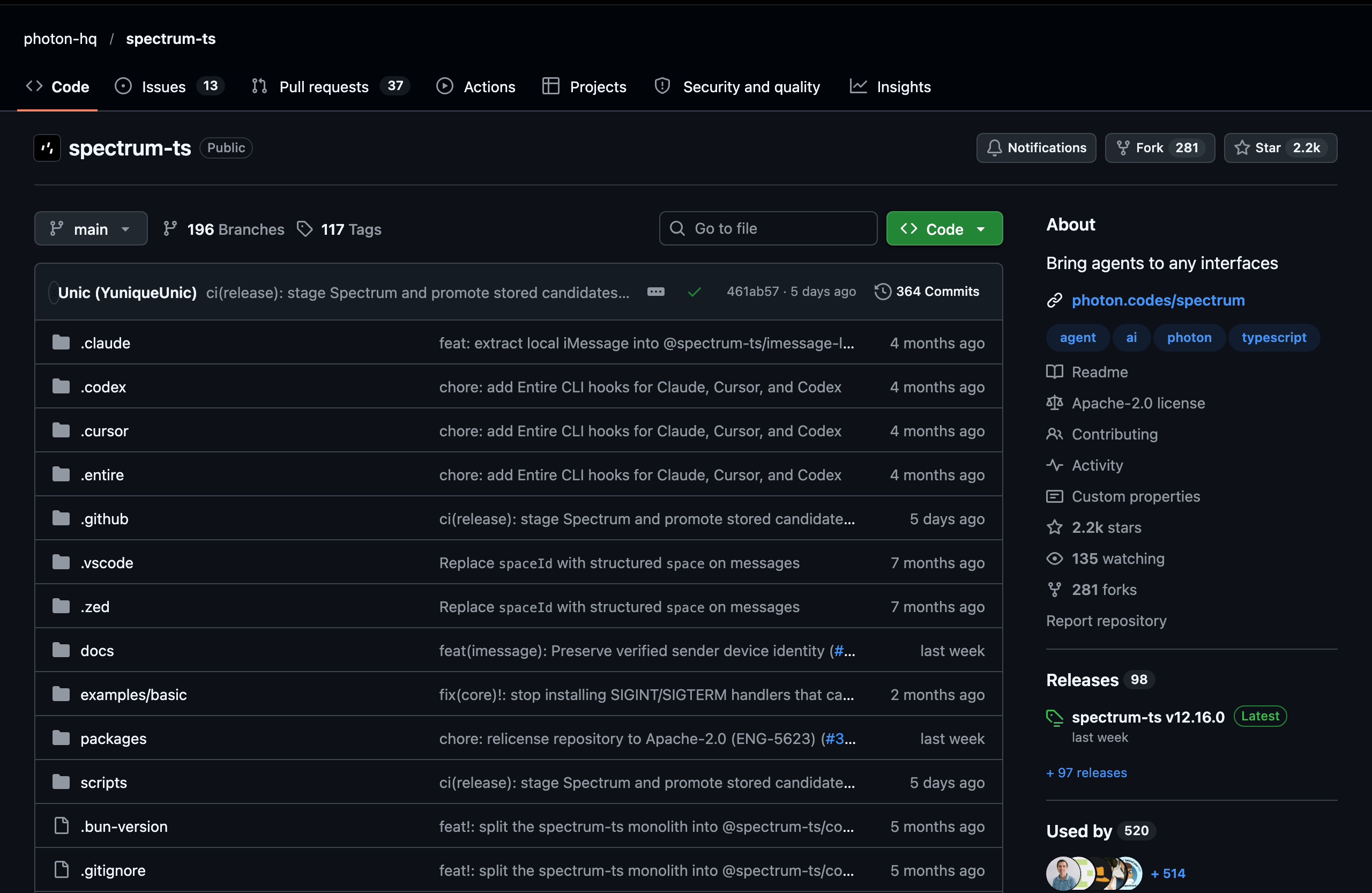
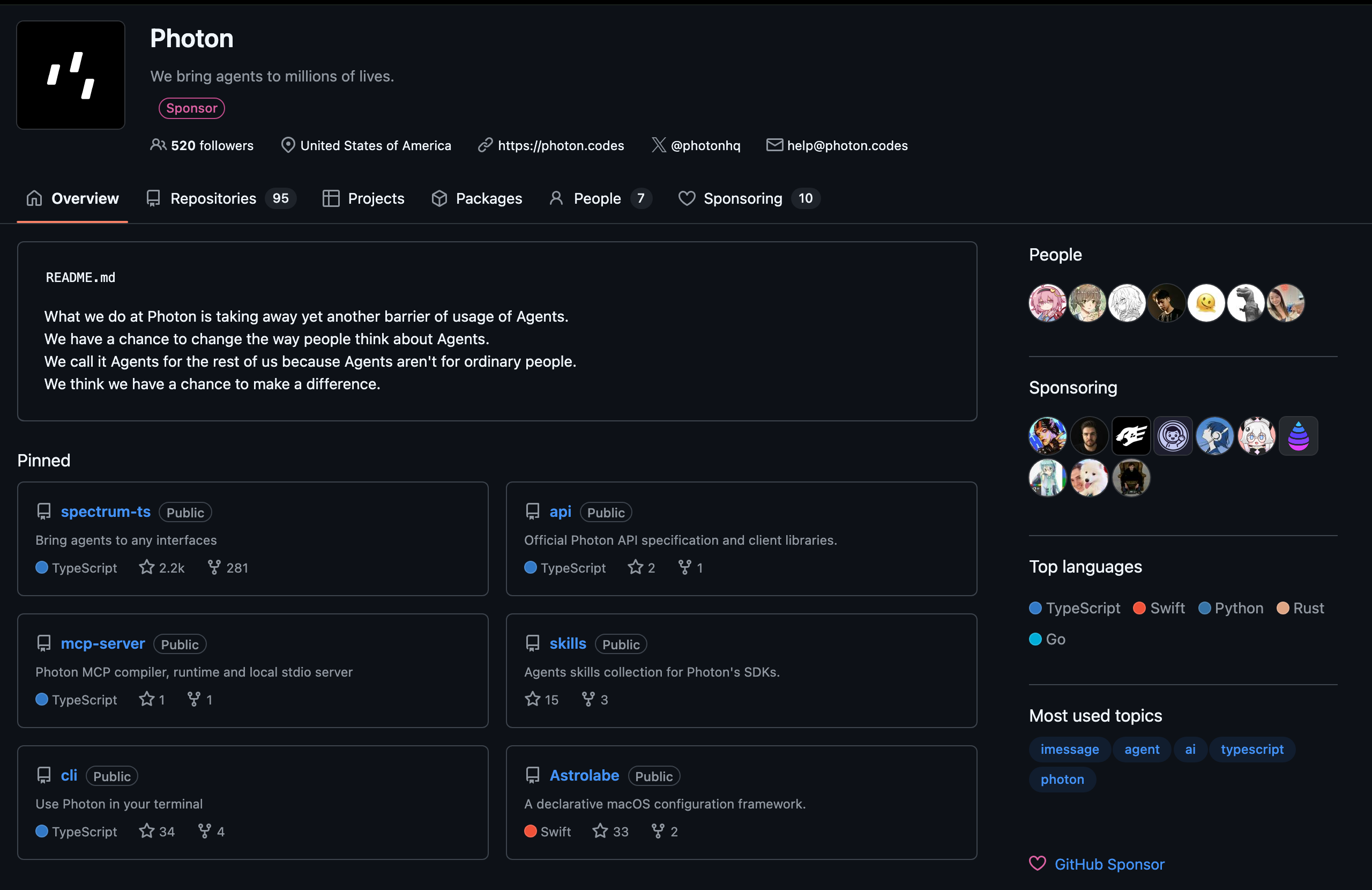
the new one is at 2,201 stars and 281 forks, with 97 releases since april
what moved it was being usable inside tools developers already run, and the weeks we shipped a lot. a hacker news post got us 33 points and not much else
ppl star what they use. make the thing easier to try and the stars catch up
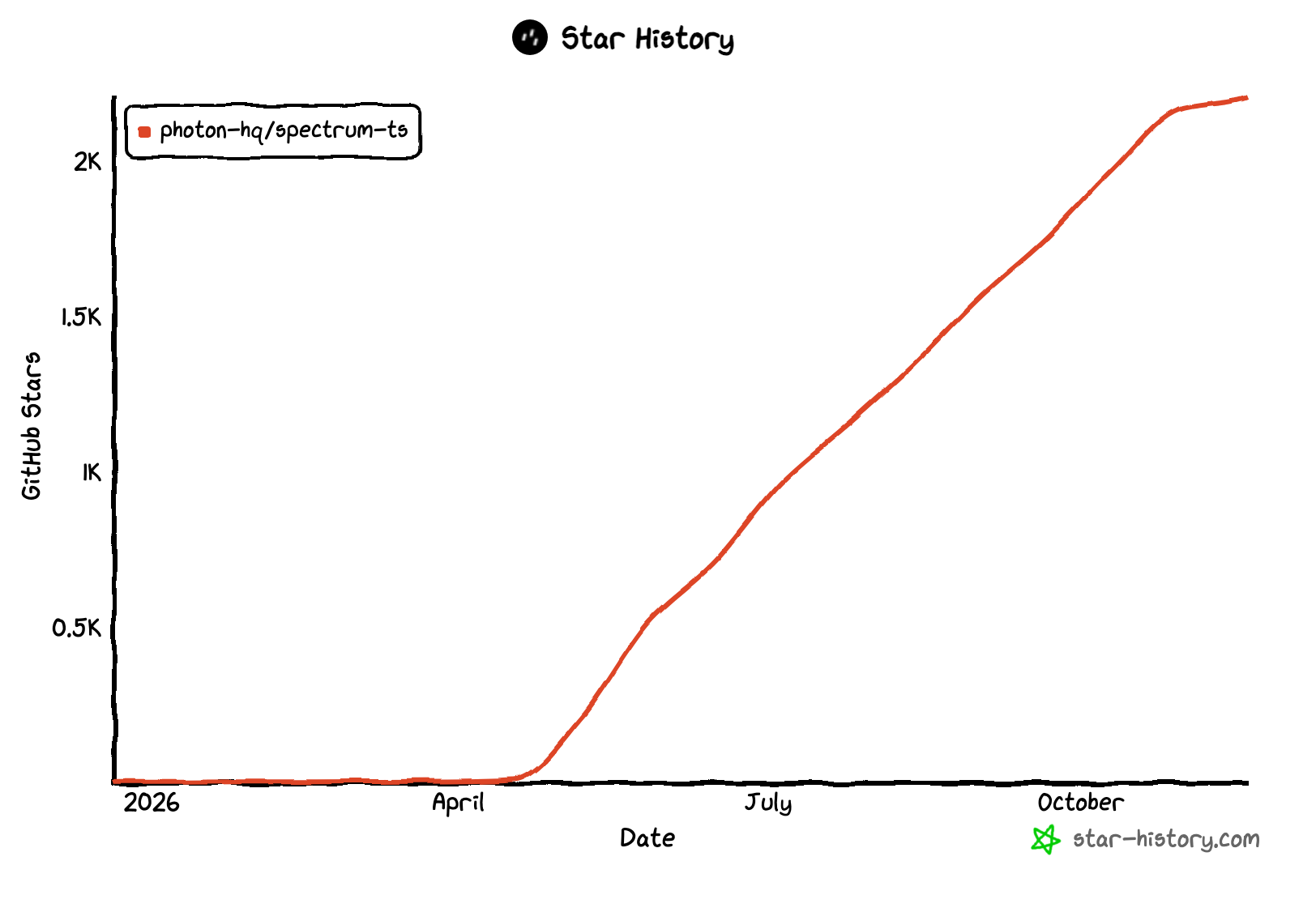
0 to 2,201 github stars in seven months
most of what we tried mattered less than i expected
what moved it:
- being usable inside tools developers already run
- shipping constantly. 97 releases since april
- starting over when our first kit was the wrong shape
what did not: posting on hacker news (33 points) and asking ppl to star it
i look at forks more than stars now. 281 ppl forked the Photon SDK, which means they are doing something with it
if you maintain an open source project, spend the time on making it easier to use
our SDK has 2,201 stars on github and 281 forks
i care more about the 281
a star is a bookmark. a fork means someone is building something with the code
we got here by shipping 97 releases since april and by being easy to try. asking ppl for stars did nothing
Open-source launch week
The week the kit went open source: strangers emailing, finding your LinkedIn, pushing PRs, then the move to SF.
strangers started hunting down my LinkedIn the week we open sourced our project
less than a week later i had left college and moved to San Francisco
my co-founder and i had built a small piece of code that connected an AI agent to iMessage. we had made side projects for years and almost none got used
then ppl i had never met were emailing me and pulling my contact info from the repo. volunteers were pushing code to something a few days old
i had debated leaving school since freshman year. that week decided it
i was enrolled in two degrees, which i ended up doing zero degree
that repo became Photon. you do not decide when something is working. other ppl tell you, by showing up before you ask
3 signs your side project is a company
all three happened to us in one week:
- strangers email you asking how to set it up
- strangers go find your LinkedIn to reach you
- strangers push code to your repo without being asked
that was the week we open sourced the integration that became @photonhq
before that, the normal result of anything i built was that nobody opened it again
we left school and moved to San Francisco in less than a week
praise is cheap. ppl spending their own time to reach you is the real signal
what happened after we open sourced a side project:
- strangers emailed me
- strangers found my LinkedIn
- volunteers started pushing code to it
- less than a week later i left college and moved to sf
- one year later: Photon, 436K downloads a month and a $4.5M seed
i did not plan any of it. it started as one repo with no plan to charge
Open source era
October to March as the open source era, then the managed product in April. Why you did not charge at first.
our company had nothing to sell for its first six months, on purpose
october to march was our open source era. a repo, some docs, and two of us answering questions
when we started, most ppl did not know an AI agent could live in iMessage. investors told us they already had ChatGPT
you cannot sell to a market that does not know the category exists
so the job was educating the market. we let developers use the code for free and watched what they built
by spring we could see the fit and the needs, and ppl wanted us to run it for them
that is when we launched Photon as a managed product, in april
founders charge early because revenue feels like proof. for us the six free months made the paid product obvious
if you still have to explain your category, do not charge yet
we gave our product away as open source for six months. what it bought us:
- developers showed us what was painful before we had to guess
- ppl could read the code, so nobody had to take our word
- time for the idea of an agent in your messages to stop sounding strange
we started charging for Photon in april, when companies asked us to manage it for them
six months with almost no revenue is a long time for two ppl who just left school. i would still teach first and charge second
how we knew when to start charging for @photonhq: the questions changed
early on ppl asked "what is this" and "why would an agent be in iMessage"
six months later they asked "can you run this for us" and "what would it cost"
listen to the questions more than the compliments. they tell you which stage you are in
daniel_t·Articlethe question i get most from other founders building developer tools is "how did you know when to start charging?"
i'm Daniel, the co-founder of Photon. we build the infrastructure that lets AI agents text ppl in iMessage and other messaging apps, so a company can give its agent a phone number and skip building an app. today we have a managed product with paid plans. for the first six months we had nothing to sell at all
tldr: if you still have to explain your category, your first product should be free. we did not charge until ppl understood what the thing was, and the six months we spent giving it away paid for themselves in ways i did not expect
how it started
Photon began as a side project. my co-founder Ryan and i had built projects at hackathons for years, and we kept running into the same wall: nobody opens a new app. so we tried putting an agent where ppl already were, which is their messages
the agent part turned out to be simple. getting it into iMessage was the hard part. so in october 2025 we open sourced that integration, the piece that had cost us the most time, and went back to work
that same week strangers were emailing me. ppl found my LinkedIn. they pulled my contact details from github. volunteers started pushing code to a repo that was only days old. i was still in college, and less than a week later we had moved to san francisco
we did not have a business at that point. we had a repo that strangers cared about, and that turned out to be the more useful thing to have
what "educating the market" means
from october to march there was no managed product and no plan to charge. i call it our open source era, and the job in that era was educating the market
that phrase sounds like something from a pitch deck, so here is what it looked like in real life. nobody was searching for "iMessage API for agents" because nobody knew it could exist. when we pitched early investors, the answer we heard was some version of "i have ChatGPT, that's enough". when developers saw the repo, the first question was why an agent would be in iMessage at all
you cannot run a sales process against that. there is no demand to capture. the only thing that works is letting ppl try it, and accepting that you might spend 10 minutes explaining what you mean every single time. that's fine. all the non-consensus stuff sounds like that at the start
a free, open source repo is the cheapest way i know to let thousands of ppl have that 10 minute experience without me in the room
what we got for free
looking back, the open source era bought us four things
the first was help. ppl we had never met read our code and fixed it. a small team cannot test every setup, and the community found problems we would not have seen for months
the second was our first revenue. after we open sourced, some ppl started paying us for the service. it was a couple hundred dollars in total, which is not even that much. but it came from strangers, and nobody had asked them to pay
the third was proof. i did not ask my parents for permission to leave school. i showed them that money. a couple hundred dollars from ppl you have never met is a stronger argument than any plan, and it was the evidence i needed for myself too
the fourth was time for the market to catch up. early this year other projects started putting agents in messaging. then a popular open source agent did it, then a wave of consumer agents. we did not move. the market walked over to where we were already standing, and when it arrived we had six months of code and users waiting
how we knew it was time
we launched the managed product in april. the way i think about the timing is simple: we started charging when we could see the fit, see the needs, and see the commercial upside, all three at once
the fit was that ppl kept using it without us pushing. the needs were the same requests coming in again and again, mostly from teams who loved the open source version and did not want to run the infrastructure themselves. the upside was that those teams were companies with real users, not only developers on a weekend
before that point, a price would have been a wall in front of ppl who were still trying to understand the category. after it, a price was a relief for teams who wanted someone else to be responsible
where this breaks
i do not want to sell open source as a growth hack, because it is not one
it does not pay for anything. during those months Ryan and i lived in a motel near the airport for quite a few weeks because it was the cheapest option we could find. a couple hundred dollars of revenue does not cover much
it also only works if the free thing is the real thing. if we had open sourced a demo and kept the useful part closed, developers would have seen through it in a day
and you have to be ready for the moment it works. the week the repo took off, we had to decide very fast whether this was still a side project. i know founders who had that week and did not act on it
what i would tell another founder
open source is the cheapest way to find out if anyone cares. give the real thing away while you are still explaining what it is. watch for strangers who use it without being asked, then for the same request showing up three times, then for a company that wants you to run it for them
when all three are there, build the thing they are asking for and charge for it. the SDK is still open source today, and most ppl still meet Photon that way
We deleted the sales call
The decision to remove the demo call when competitors require one. Short and contrarian.
we deleted the sales call
more than half of our users now come from word of mouth
in our space the normal way to get access is a demo. fill in a form, wait for an email, sit through 30 minutes of slides
then maybe you get a key
developers do not want that. they are curious and very opinionated, and they want to try a tool on their own time
so we removed all of it. on Photon you click, you get access, and you put an AI agent in iMessage for free
when trying something costs nothing, ppl try it. when it works, they tell the next developer
we still talk to customers a lot. it just happens after they are already using us, and the conversation is much better
if your buyer is technical, delete your sales call
most of my company's competitors require a demo before you can touch the product. we removed that. what i learned:
- the best developers are the least willing to book a meeting to see an API
- free access is the best pitch. the product explains itself faster than i can
- word of mouth only works if the next person can also start in a minute
more than half of our users now come in through someone telling them
let ppl in first and earn the conversation
nobody has ever finished a demo call thinking "great use of 30 minutes"
so @photonhq does not have one. you click and use it for free
the product turned out to be better at explaining itself than i am. more than half of our users come from word of mouth now
if you gate a developer product behind a meeting, test removing it for a month
Selling to a CTO
Your playbook for selling to developers: let them use it free, talk when usage ramps. Pairs with the sales call post.
the hardest deal in B2B is selling to a CTO
so we stopped pitching them. i have written code for about ten years and i know how that buyer thinks
send an engineer a deck and they do not believe it. they read the docs, then the github issues, and form their own view before replying to anyone
so at Photon we give them the tool for free and let them break it. there is no sales call to get access
then we wait. if the product is good, their usage grows, and they come to us because they need more
our bigger deals have come that way, from teams that were already running agents on us
it takes longer than a good pitch. but the deal holds, because the CTO decided with their own hands
how to sell to a CTO in 4 steps:
- do not pitch. the more polished the deck, the less they trust it
- let them use it for free, with no call
- wait for the usage to ramp
- now talk, about their system and their scale
this is how we sell @photonhq, and the person saying yes is almost always a CTO or lead engineer
it is honest. the product works for them or it does not, and they find out before any money moves
it only works if your product survives being tried without you in the room
a CTO reads your docs before your landing page
and your github issues before your docs
i know because that is what i do when someone sells me software
so my company built its whole go-to-market around being inspected. the SDK is open source and access is free with no call
spend less time on the pitch and more on what engineers find when they go looking
daniel_t·Articlethe hardest deal to do in B2B sales is selling to a CTO
i know this from both sides of the table. i have been writing code for about 10 years, and i am the person who closes a vendor's tab the moment i see "book a demo". i am also the co-founder of Photon, where we sell messaging infrastructure for AI agents to engineering teams. our customers are developers and CTOs who want their agent to text ppl in iMessage, WhatsApp and other apps without building that plumbing themselves
so i sell to the exact kind of buyer i am, and i know how much that buyer dislikes being sold to
tldr: you do not sell to a CTO. you let them use the product, you make sure it works the first time, and you talk when their usage tells you to. here is how we set that up
why the normal playbook fails
developers are talented, curious and very opinionated. those are the three things that break a normal sales process
talented means they can judge your product themselves, faster than you can explain it. curious means they will go around your marketing and read the docs, then the github issues, to see what is really going on. opinionated means they have already decided what a good API looks like before your first call
a slide deck does not survive that. neither does a gate. if a CTO has to book a meeting to see an API, they will find the tool that lets them see it tonight, and that tool wins by default
step 1. remove the call
most companies in our space require a sales call or a demo call before you get access
we removed all of that. you click and you use it for free
this felt risky when we did it. a call is where you learn about the customer and shape the deal. what we found is that developers who try the product first show up to a later conversation already knowing what they need, and those conversations are shorter and better
step 2. make the first 10 minutes work
removing the call moves all the pressure onto the product. if the first try fails, there is no second try, and there is no salesperson to smooth it over
so we treat the first ten minutes as the real pitch. before a release goes out, i give our SDK to a coding agent and ask it to build something from scratch with no help. our goal is that it gets to a working build at least 80% of the time
i test it that way because the user who matters has changed. a lot of integrations are now written by an AI assistant on behalf of a developer. if the agent cannot figure out our SDK from the docs, the CTO never even sees our product. they just see their assistant give up and suggest something else
step 3. give away enough to be useful
our free plan is $0 on a shared number, for up to 10 users
that number matters. ten users is enough to build a real prototype, put it in front of a team, and have a few ppl text the agent for a week. it is enough to answer the question "does this work for us"
a lot of free trials are not. they expire in 14 days, or they cap you just before the prototype works. a trial that ends before the developer has something to show their team is a sales call with extra steps, and CTOs can tell
step 4. wait for usage
this is the part that takes patience. after someone signs up, we do not chase them
what happens with the good ones is that the usage ramps by itself. the prototype becomes a feature, the feature gets real users, and at some point the team needs more lines, more volume, or a contract. that is when we talk
by then the CTO is not evaluating us. they are already running on us, and the conversation is about scale and reliability. the bigger deals we have done came this way, from usage first and a conversation second
step 5. when something breaks, answer in public
developers talk to each other, and they talk most when something goes wrong
we have had bad days. when a customer posted publicly about a disruption, i replied publicly. i apologized, said we owed them better communication, and sent my own number so they could reach me directly
i do not think you can hide from technical buyers. they will find the outage thread anyway. what they are checking is how you behaved in it
where this breaks
this approach is not free
it only works if the product really holds up when a stranger tries it alone. if your product needs a human to explain it, removing the call just means ppl leave quietly
it is also slow at the start. waiting for usage to ramp means months where the revenue chart is flat and you have to trust the usage chart instead
and it does not replace talking to customers. we still talk to them all the time. we just do it after they have used the product
the short version
- do not pitch
- let them use it for free
- make the first try work, for the developer and for their AI assistant
- give away enough to build something real
- talk when the usage ramps
- when it breaks, say so in public
more than half of our users come from word of mouth, and i think this is why. CTOs talk to other CTOs, and what they pass along is "i tried it and it worked"
if you are building an agent and want to see what i mean, you can try Photon for free without talking to me
50K developers, no ads, no SEO
Developer count with no ads and no SEO.
tens of thousands of developers signed up for our product
our ad spend so far is $0
everyone had the same growth advice for us. run paid ads. secure your SEO
we did neither
i kept asking who our user was. it is a developer building an AI agent, and i could not remember ever picking a developer tool because of an ad
developers pick tools because another developer told them, or because the tool was already inside something they use
so that is where the effort went. we open sourced the SDK and made Photon free to try with no sales call
and we got built into the agent frameworks ppl already run
more than half of our users now come from word of mouth
work backwards from how your user actually finds things
the marketing for a developer tool is mostly the developer tool
tens of thousands of developers signed up for @photonhq without paid ads or an SEO strategy. the effort went here instead:
- into the first few minutes, so something works fast
- into being free to try without talking to us
- into getting built into frameworks developers already trust
- into showing up in person
we are only valuable if ppl are using us
put your first marketing dollar into the product and your second into the ppl
my company's marketing budget:
paid ads: $0
SEO: $0
pho for founders: not $0
the pho part is real. this year i said i would buy 100 founders pho in the bay area. i pick the restaurant and there is no agenda
tens of thousands of developers have signed up anyway. more than half found us because someone told them

Shipping inside Hermes
The Hermes integration as the best growth move: get built into the tool people already use.
our best growth move this year was getting built into someone else's product
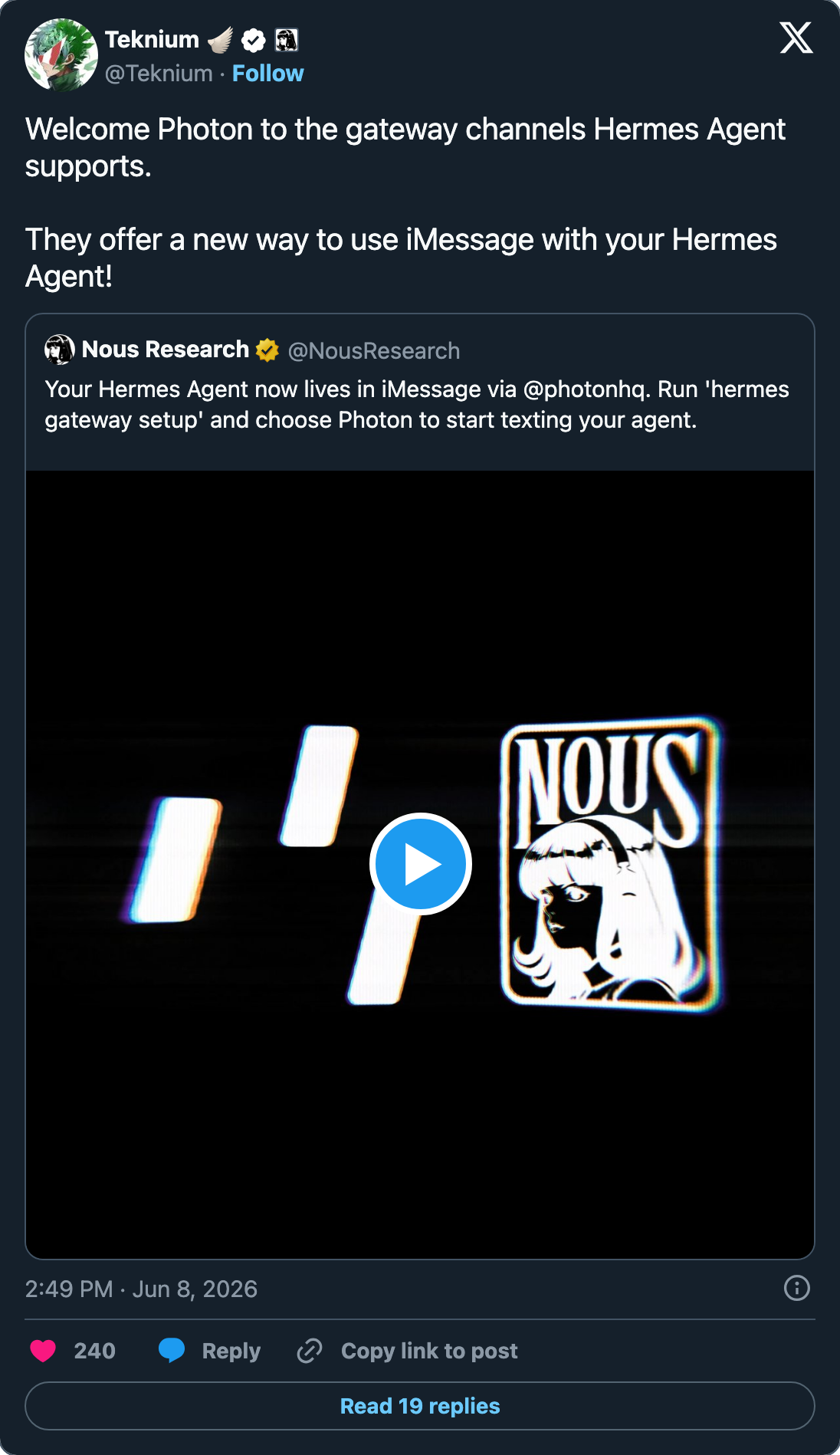
then Hermes Agent happened. it is a popular open source AI agent that developers run for themselves
their users wanted to text it from iMessage, and Photon became the way to do that. you set it up once and message your own agent from the blue bubble
we made it free forever for personal use, so there was no reason not to try
the 1 minute setup clip got 137K views here. my co-founder Ryan's post about it is the best one he has ever had
it worked because we stopped asking developers to come to us. they were already inside Hermes
find the product your users live in and be useful inside it
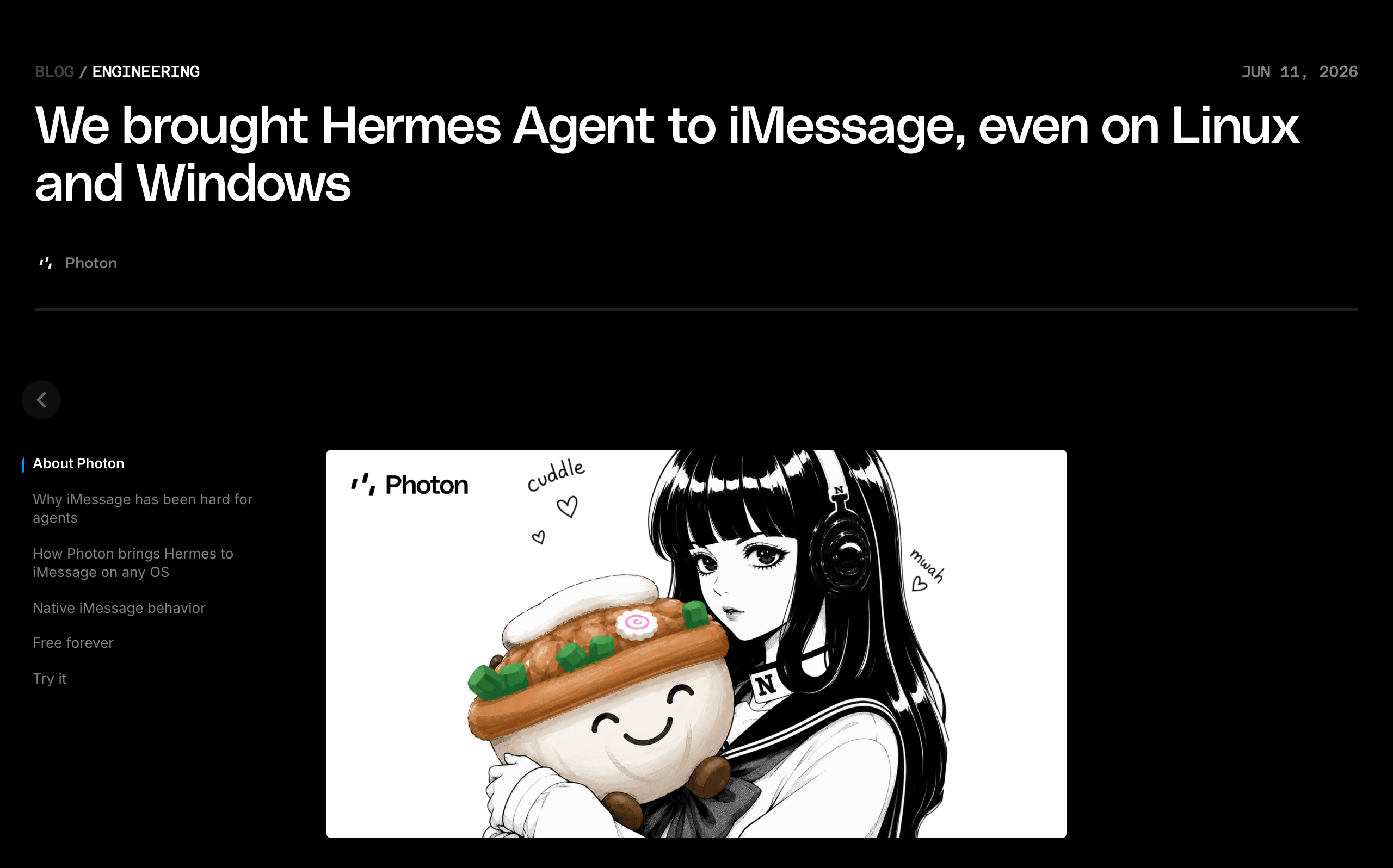
distribution for a developer tool is one thing: be the default inside something bigger
what one integration with Hermes Agent, a popular open source AI agent, did for us:
- put us in front of ppl who were not looking for us
- gave us a demo anyone understands. the 1 minute setup clip did 137K views
- gave strangers a reason to write tutorials
a campaign gets attention for two days and then you start again
an integration brings ppl to @photonhq every day the bigger product grows. i would do this before any launch
nobody wakes up wanting infrastructure. they want their agent to do something
so we stopped asking developers to come to Photon and went where they already were, inside Hermes Agent
ppl set up Hermes on iMessage and use us without thinking about it. the setup video passed 137K views
if your product needs explaining, find the partner whose users already have the problem
Free tier as growth engine
The free plan as the growth engine, not a trial.
most ppl on our free plan will never pay us
that is the plan
a lot of free plans are a trial with a timer on it. ours costs $0, gives you a shared number, and lets up to 10 ppl use your agent
that is enough to build something real and put it in front of friends or first customers
we decided that is fine, because we are only valuable if ppl are using us
and they are not free riders. they post what they built and tell the person at their company who does have a budget
more than half of Photon's users come from word of mouth, and a lot of it starts on the free plan
it is where our growth starts
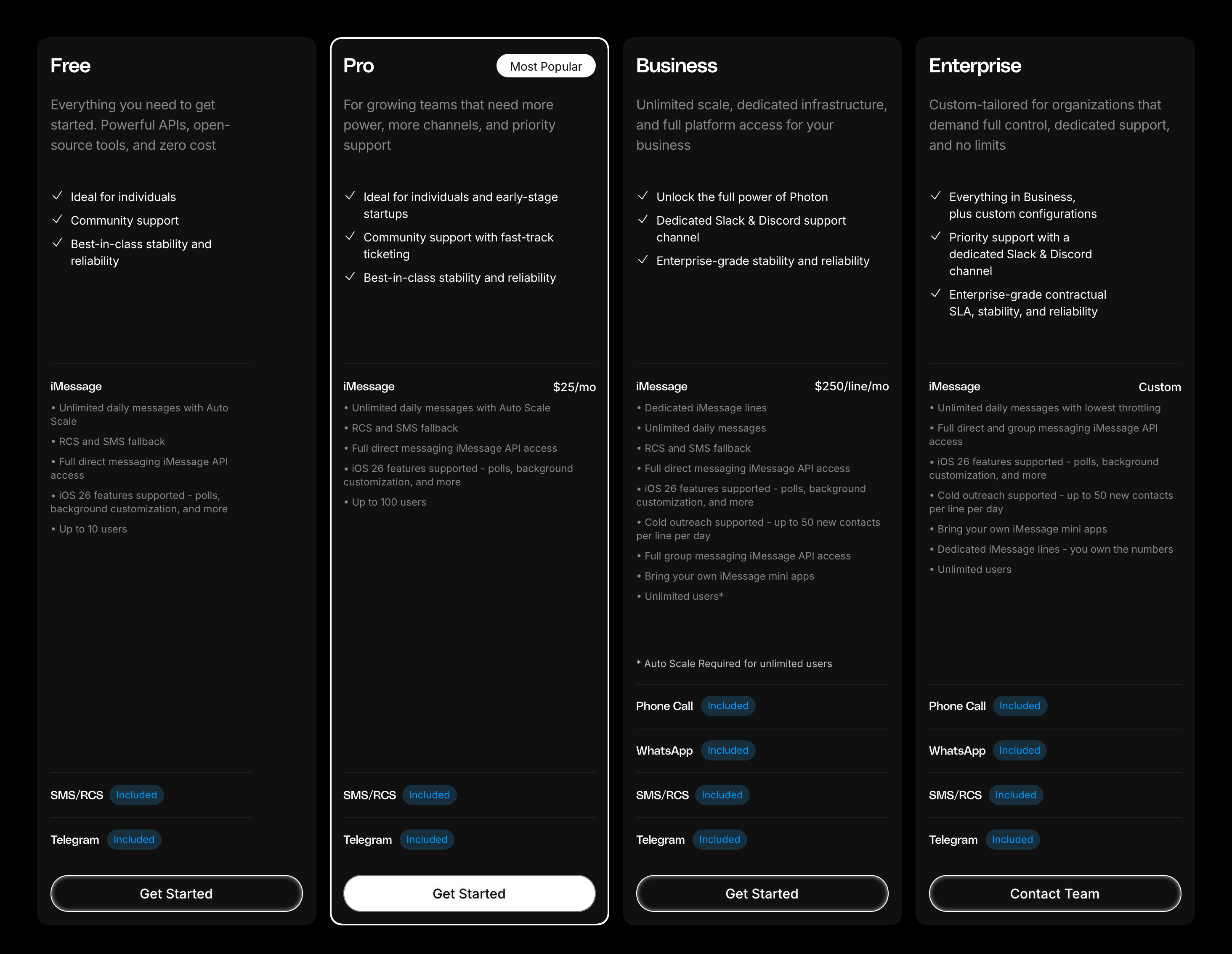
a free plan is the cheapest marketing a developer product can buy
ours is $0 on a shared number for up to 10 users. how i think about it:
- free has to be useful enough to finish a small project
- the first 10 users are when a builder learns if anyone wants their agent
- free users talk. more than half of our users come from word of mouth
it costs my company something, but less than ads would
and ads do not leave you with a working agent built on your platform
the first 10 users of any agent built on @photonhq are on us
i have built a lot of projects nobody used. the hardest part was never the code. it was getting the first few ppl to try it
so we made that stage cost nothing. some of those projects become customers. most do not, and that is ok
Launch video by a music video team
How the launch video got made: no launch video agencies, a music video team instead.
we got 1.67M views on a launch video for a developer tool
and i said NO to every launch video agency to make it
every agency pitched us the same thing. fast cuts, a founder walking, big text on screen
so we hired a music video and film team instead. they had never made a startup video, which was the point
they did not know the template. they just made something you would watch on purpose
it is still the biggest thing that has happened to @photonhq, and it is how a lot of developers first saw an AI agent living inside iMessage
if you are planning a launch: hire ppl who hold attention for a living, show one thing the product does, and link something ppl can try that day
how we brief a launch video after our last one did 1.67M views:
- do not hire ppl who make launch videos
- hire ppl who make things you would watch on purpose
- show the product doing one thing you can picture
- link something ppl can try the same day
ours was made by a music video team. i turned down every startup video agency we talked to
for Photon that one thing was an agent sending a small app inside a text thread. no explaining needed
the parts i wanted to cut were the parts the film team fought for. i am glad i lost
ppl keep asking which agency made my company's launch video
none of them. a music video team did
every agency pitch looked like a video i had already seen, so we went to ppl who had never made one
1.67M views later, i would do it the same way
ThePrimeagen roasted our landing page
ThePrimeagen roasting the landing page and the traffic that followed. Self-roast with a receipt.
the most attention our website ever got was from someone making fun of it
we had put the landing page together fast and moved on to the product, like most early startups
then ThePrimeagen found it. he is one of the most watched programmers on the internet, and developers trust him because he does not hold back
he roasted our page, and he was right. it was chopped
we went viral because of it. developers who had never heard of Photon came to see what he was laughing at
some of them stayed to look at what we build, which is AI agents you can text in iMessage
so i thanked him in public, and i meant it
if we had gotten defensive, the story would have been about that. because we laughed too, it was about the product
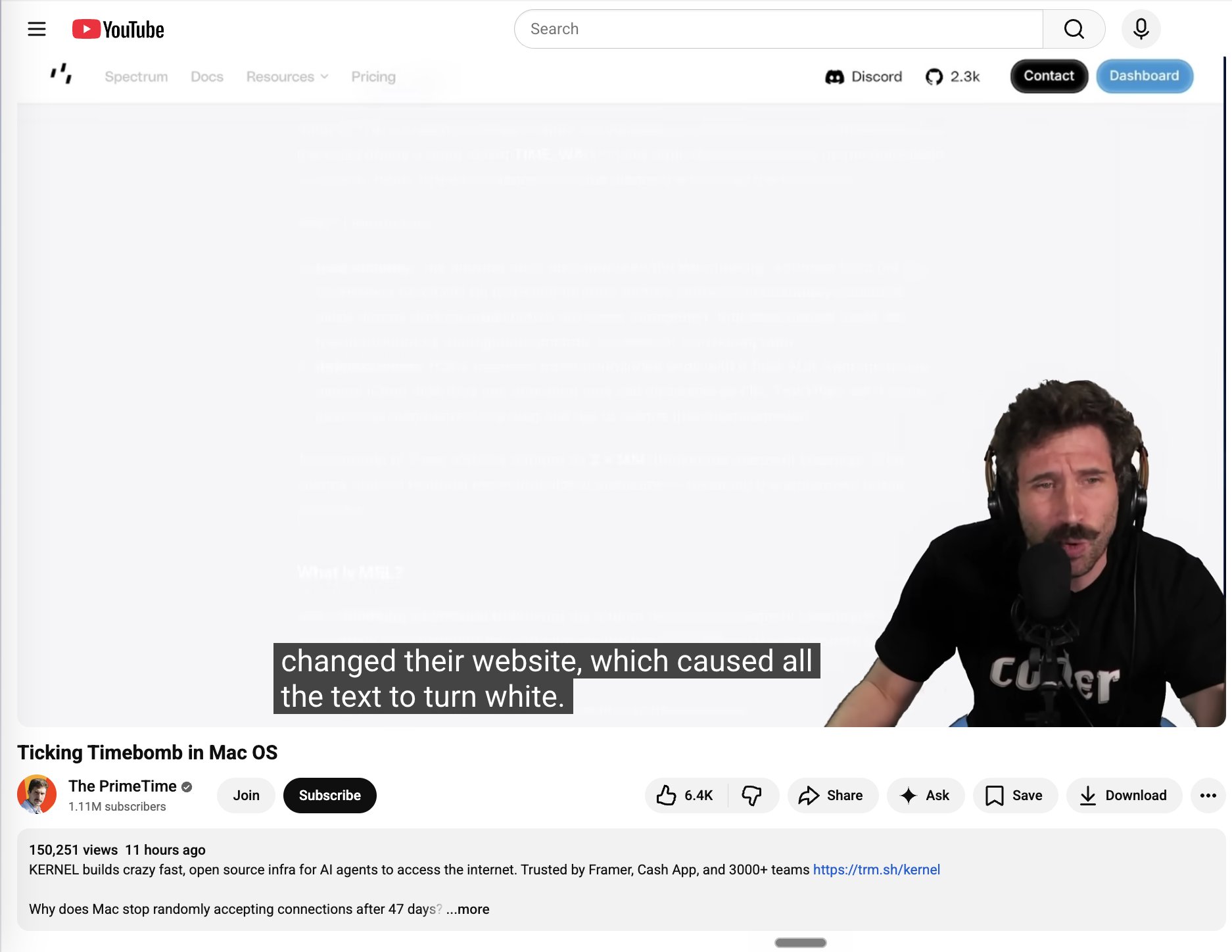
getting roasted in public is a growth channel, if you handle it well
a programmer with a huge developer audience made fun of my company's landing page. we went viral because the page was too chopped. what i learned:
- do not argue. he was right, and saying so cost nothing
- say thanks, in public
- have a product behind the page for the ppl who come to laugh
- do not stage it. it only works when it is real
it is probably the most honest feedback you will get all year, and everyone is watching how you respond
a growth channel nobody puts in the pitch deck:
being made fun of by a famous programmer
@ThePrimeagen roasted our landing page in front of his whole audience. the page deserved it
so i posted that we went viral because it was too chopped, and thanked him
agree with the parts that are true, and make sure @photonhq is ready for the visitors
$3,000 builder contests
What two $3,000 contests returned: builders posting their own demos.
the best ad for our product was made by a stranger
it cost us a $3,000 prize
the hard part of marketing Photon is showing what it can do. you can put an AI agent in iMessage, and after that the answer is "almost anything"
so this fall we put up $3,000 and asked developers to build whatever they wanted on it. then we did it again the next month
ppl shipped real agents and posted them on their own accounts. one demo passed 54K views. another passed 39K
when we say it is easy to build on, that is marketing. when a developer shows what they built in a weekend, other developers believe it
pay developers to build before you pay a platform to show them ads
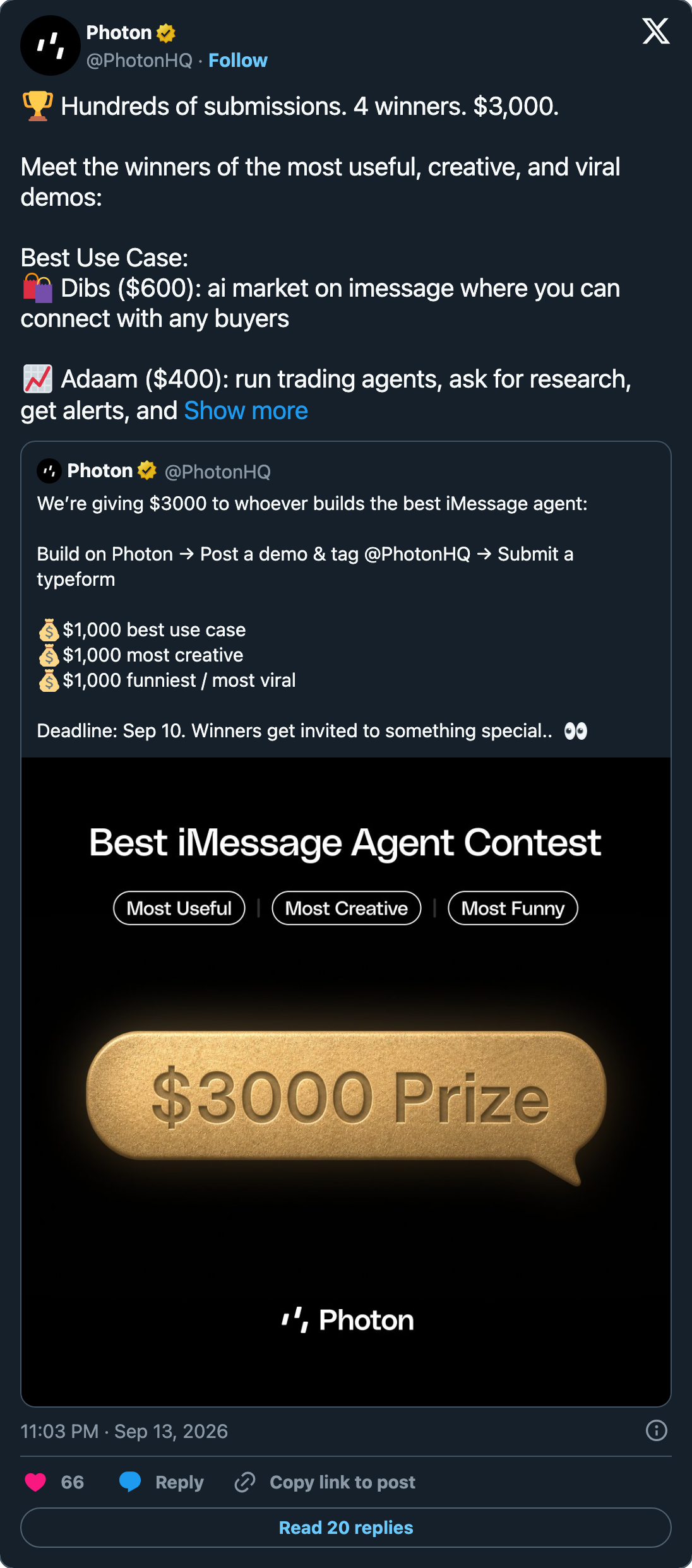
$3,000 buys one ticket to a big tech conference
we spent it on a builder contest instead
twice. what came back:
- demos we could never have made ourselves
- reach we did not pay for. one entrant's post did 54K views, another 39K
- every rough edge in our SDK, found in one week
at a conference you tell ppl what your product does. in a contest they show each other
it works for @photonhq because it is free to start, so nobody needs permission to enter
want developers to trust your product? show them what another developer built
my company ran two contests with a $3,000 prize. the entrants posted their own demos, and two of them did 54K and 39K views
i have not found a better way to spend a few thousand dollars
Events as distribution
Pho, go-karts and the App Funeral: why cheap, strange events beat rooftop happy hours.
the best event my company ever hosted was a funeral
we held it for 67 apps
we believe a lot of apps are going to turn into conversations with AI agents. so for our first developer day we skipped the hotel ballroom
we found a mortuary building from 1914, brought in a real coffin, and invited developers to say goodbye
hundreds showed up
two weeks later TechCrunch wrote about our funding, and the story opened with the funeral
i have a rule now. the quality of a startup event is directly proportional to how likely your mom would tell you not to go
Photon is a small team with a small budget. an event is worth it when ppl who were not there hear about it later
3 events that worked for a startup with a small budget:
- pho. i buy founders lunch. i pick the place, no agenda, no pitch decks
- go-karts, in place of another rooftop happy hour
- a funeral for 67 apps, in a 1914 mortuary with a real coffin
hundreds of developers came to the last one, and TechCrunch led its story about our funding with it
nobody posts about a happy hour. ppl posted the coffin
we think apps are dying and agents are replacing them, so we buried some. that image explained @photonhq better than our website


my test for startup events:
the quality is directly proportional to how likely your mom would tell you not to go
so far we have done pho lunches with no agenda, go-kart races, and a funeral for apps with a real coffin
my mom would have said no to the last one. hundreds of developers came
do the thing that sounds like a bad idea to your mom
daniel_t·Articlea ticket to a big tech conference in Las Vegas costs about $3,000, and the hotels around it are $500 a night. for a startup with a handful of ppl, sending two of them is most of a month of marketing budget, spent on a badge and a booth nobody walks past
i'm Daniel, the co-founder of Photon. we give AI agents a phone number so ppl can text them in iMessage, which means our customers are developers and founders building those agents. reaching them in person matters a lot to us. i just do not think the usual way of doing it works for a company our size
tldr: the events that worked for us were cheap, a little strange, and something you would tell your mom about. the expensive ones did nothing. here are the three we ran and what each one taught me
first, how i found out
i did go to that conference in Las Vegas. i did not buy the ticket
i snuck in. no badge, no invite. i found an empty table, put our posters on it, and pitched Photon to whoever walked by for as long as i could before security noticed
it was a stunt, and i would not build a strategy on it. but standing there i watched how the room worked. the ppl with the most expensive booths were talking to other vendors. the conversations that mattered were happening in the hallways, for free
the rule
after that i started paying attention to which events i actually remembered a month later, and i ended up with one rule
the quality of a startup event is directly proportional to how likely your mom would tell you not to go
it is a joke, and it is also the most reliable filter i have found. a rooftop happy hour passes every mom test, and nobody remembers it. the three events below did not
pho
i'm an introvert. meeting ppl is hard for me, and the standard way founders meet in san francisco is a three hour dinner at a nice restaurant. i did not want to spend three hours of my evening that way when i had work to do
so earlier this year i posted that i was going to buy 100 founders pho in the bay area. i pick the restaurant. there is no agenda and no pitch deck. you show up, we eat, and you leave when you want
lunch over a bowl of pho is short and it is hard to perform in. ppl talk about what they are stuck on instead of what they are raising. some of the most useful conversations i have had about where agents are going happened that way, with founders who later tried Photon because they had met the person behind it
it also became a running joke around the company, since pho is the first three letters of our name
go-karts
when YC's Startup School came to town, the whole city filled up with side events, and almost all of them were the same panel in a different room
we ran a go-kart rally. you did not have to be part of Startup School to come
there is not much to explain about why it worked. founders who had been sitting in talks all day wanted to do something with their hands. ppl who raced each other for twenty minutes had more to say to each other afterwards than ppl who had exchanged cards. and when someone asked what Photon was, we were the ones who had given them the best hour of their week
the funeral
our first developer day was a funeral for apps
we believe a lot of apps are going to be replaced by agents you simply text, so we took that belief literally. we rented a 1914 mortuary, brought in a real coffin, and held a service for 67 apps. hundreds of developers came, and after the funeral we ran panels with ppl from Vercel, OpenAI and Stripe
two weeks later we announced our $4.5M seed round, and TechCrunch opened the story with the funeral
i think about that a lot. we could have spent the same effort on a normal launch party and a reporter would have had nothing to open with. the coffin gave them a first paragraph
why strange beats expensive
a rooftop happy hour is the same as the last rooftop happy hour, so nobody posts about it and nobody describes it to a friend
ppl posted the coffin. ppl told their co-founders about the go-karts
that is the only test i use now: an event is distribution if someone who was not there hears about it. by that test a quiet lunch can beat a conference booth, because the lunch gets retold
the other thing strange events do is say what you believe. a funeral for apps tells you what Photon thinks about the future before anyone gives a talk. a booth tells you we had budget
where this breaks
i should be fair to the other side
conferences are not useless. i speak at some, and if someone invites you on stage in front of your customers, go. my problem is with paying thousands of dollars to stand in a hall
strange also does not fix a weak product. an event gets ppl to try you once. if what they try is not good, you have a fun story and no users
and the bit has to be yours. if your company has no opinion that a funeral would express, do not hold a funeral
what i would copy
pick something cheap. make it specific to what your company believes. keep it small enough that you can talk to everyone who comes
we think apps are dying, so we buried some. i would rather do that once a year than buy a booth every quarter
The residency
Flying people to SF twice. What a residency buys a seed stage company.
we have paid strangers to fly to San Francisco and live with us, twice
we are a seed stage company. it is one of the stranger things we spend money on
the first time was a hacker house, from november to january. the second was a week in may with flights, food and housing covered
when i posted the second one, 264 ppl replied asking to come
part of it is personal. i spent my teens at hackathons, and the best things in my life came from rooms full of ppl who build
the rest is practical. residents build on Photon all day, so we see every place the product is confusing
a week of living with your users teaches more than months of surveys
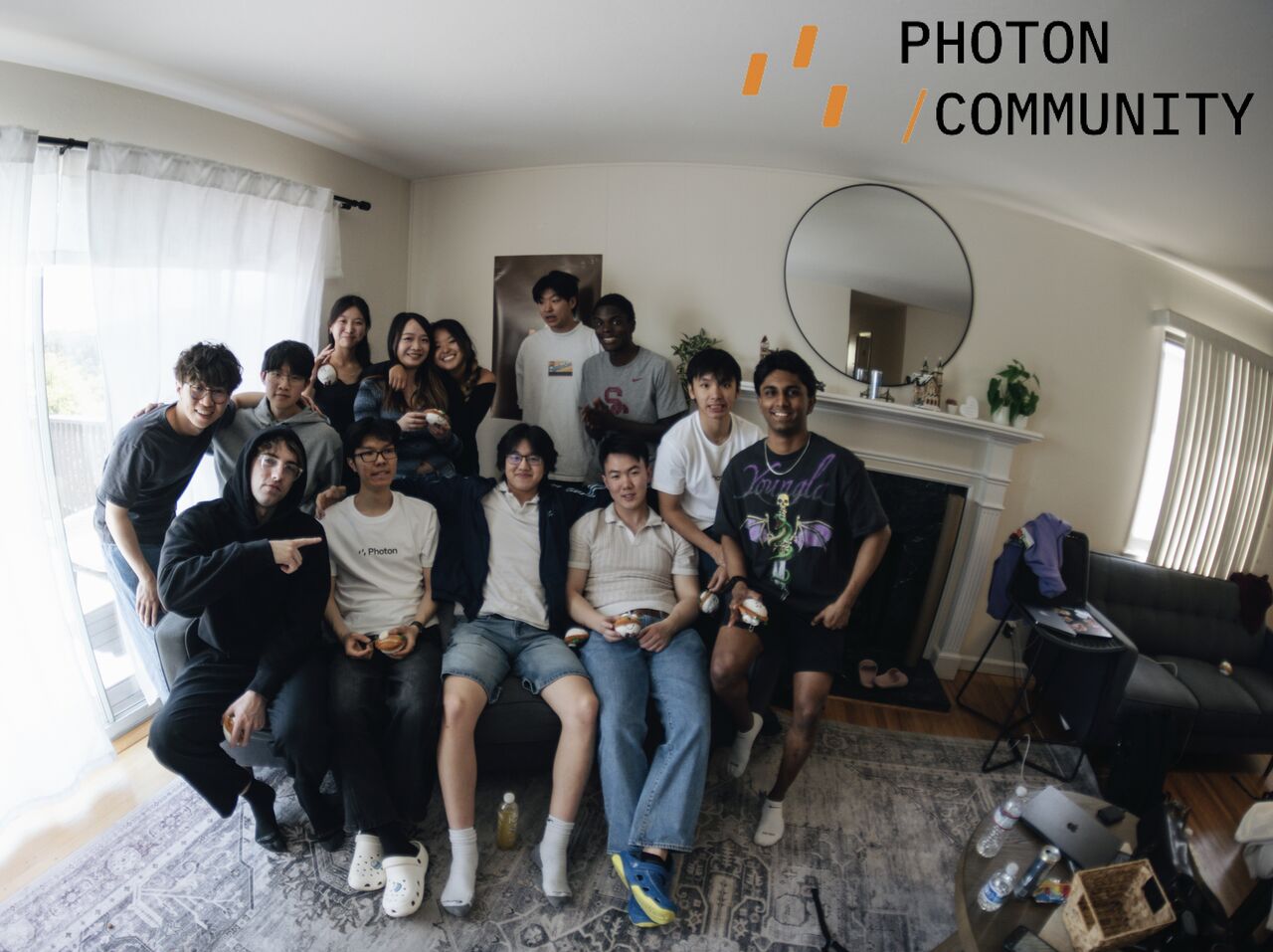
if your users are developers, live with a few of them for a week
we have done it twice at @photonhq. we fly ppl to San Francisco, cover flights, food and housing, and build together. what a small company gets:
- product feedback no support ticket will show you
- a way to meet great ppl before any interview
- stories. residents make things and post them
it is not cheap for a seed stage company
it is still the kind of thing i wish existed when i was a student
i posted "I will fly you out to sf, all expenses paid"
264 ppl replied
it was not a giveaway. my company brings a small group of engineers, designers and growth ppl to live and build with us
they use the product harder than anyone, and we learn more that week than in months
Hackathon sponsor math
From hackathon kid to hackathon sponsor: what you see from both sides of the table.
i went to 21 hackathons as a student
the first prize i ever won was $25
i never understood why companies paid to sponsor them
back then sponsors were the tables with free stickers. except one. at my first hackathon someone from Twilio's developer team walked over and helped me
i was in middle school. i was nowhere near being a customer
now my company sponsors hackathons. at HackPrinceton more than 600 ppl built for 72 hours
from that side of the table it finally made sense. hundreds of developers try your product at once, tired and on a deadline
if your docs are confusing, you find out that night
and somewhere in the room is a kid who will not be a customer for years. helping that kid is the reason Photon shows up
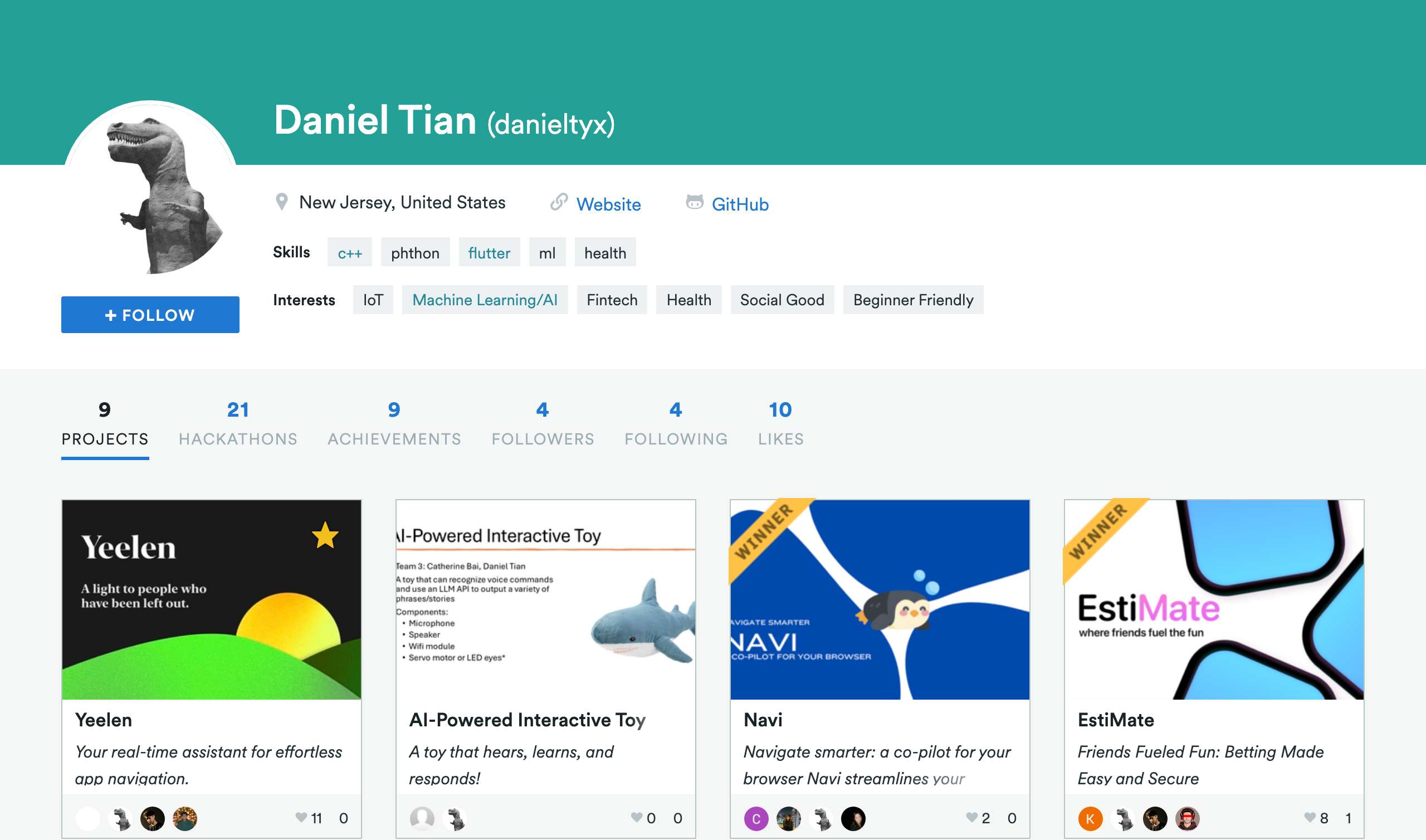
sponsoring a hackathon is the hardest test you can give a developer product
the math, from someone who went to 21 as a student and now sponsors them:
- hundreds of developers try you in one weekend. 600+ at HackPrinceton
- they are tired and rushed. whatever breaks will break
- you watch ppl get stuck on your quickstart in real time
what you do not get is customers. almost nobody there has a budget
we sponsor with @photonhq anyway. the goal is a product that survives the weekend
my hackathon career:
- middle school: my first one. a sponsor's engineer walks over to help me
- 2020: first prize, $25
- 2024: three sponsor prizes in one weekend
- 21 hackathons in total, and not one project survived
- 2026: Photon sponsors them now. 600+ ppl building for 72 hours at one
i sponsor because a sponsor once helped a kid who was nowhere near being a customer
Founding stories
39 postsEvery hackathon project died
The spine of the origin story: every hackathon project died after the event, and the lesson was distribution.
i built projects at 21 hackathons and almost every one died within a week
some of them won. one took three sponsor prizes in a single weekend. the first prize i ever got was $25
it did not matter. nobody opened any of them again after the event
for years i blamed the ideas. then i noticed the winners died the same way the losers did
every project asked a stranger to go somewhere new. a link, an app, a website. nobody does that for a weekend project
the only fix i have found is to put your product in front of their face, in a place they already open every day
that is why Photon lives inside iMessage. it came from watching my own projects die 21 times
prime example of trusting the process in tech:
- 2020: a mental health assistant. won $25, nobody used it
- 2023: a design tool. won best design, nobody used it
- 2024: an estimating app. won 3 sponsor prizes, nobody used it
- 2025: an AI agent. won another prize, nobody used it
- 2026: Photon. 436K downloads a month and a $4.5M seed round
it took 21 hackathons to build one thing ppl kept using
every dead project had the same problem. nobody opens a new app twice. so we put agents inside iMessage, where nothing has to be opened
things i built at hackathons, and how they ended:
- a mental health assistant. won $25. dead in a week
- a design tool. won best design. dead in a week
- an estimating app. won 3 sponsor prizes. dead in a week
- an AI agent. won a prize. dead in a week
- Photon. 436K downloads a month, 2,201 github stars, a $4.5M seed. still alive
let it all work out
The clone in my phone number
The clone wired into your own number, and friends who did not notice.
i wired an AI clone of myself into my own phone number
most of my friends did not notice
it started as a hackathon project called Daniel Agent. an AI version of me on a website, and nobody visited
so i connected it to my personal number. anyone who texted me was now texting the agent
it reacted to messages and sent pictures. ppl saw "Daniel" in their contacts and had no reason to doubt it
i am also not very good at texting, which probably helped
the same product got zero visits as a website and constant use in a text thread. the model was the same. only the place changed
that experiment is what Photon is built on
nobody used my AI product until i made it impossible to avoid
it was a clone of me on a website, and it got the polite silence every hackathon project gets
then i plugged it into my own phone number. that basically forced ppl to use it, because all they did was text me
usage went from nothing to all day with no marketing. most ppl did not even realize it was an agent
if nobody uses what you built, look at where it lives before you change what it does. that is the whole idea behind @photonhq
my friends texted an AI for a week and thought it was me
it reacted to their messages and sent pictures, and my name was on the contact
i'm not very good at texting, so maybe that helped
getting it into iMessage was the hard part, and that part became my company
The hard part was never the model
The model was easy, getting into iMessage was the work, and that plumbing became the product. Written as "we".
the first thing strangers paid us for had nothing to do with AI
we were building an AI clone of me. an agent that answers texts the way i would
the agent was the easy part. a wrapper around a language model with my chat history in it
then came the integration. getting it to send and receive real messages in the app my friends use took everything else
a personal clone is super simple until that part
so my co-founder Ryan and i open sourced the plumbing in october 2025. strangers started using it, and then paying for it
that is how Photon started. we set out to build an agent, hit the wall every agent developer hits, and built the way through it
if you are building an AI agent, the AI will be the easy part
our first agent was a thin wrapper with some prompt work, and it held a conversation fine
getting it into a real text thread, with real delivery, was a much bigger job than the agent itself
everyone was working on making agents smarter. very few ppl were working on making them reachable
so we open sourced that last mile, and it became Photon. developers write the agent once and we get it to where the person already is
everyone is working on making AI agents smarter
we spent october 2025 on something dumber: making one show up in iMessage
it was the piece we open sourced, and the piece strangers started paying for
the thing you struggle with most on the way to your idea is often the real product. for us it became the whole company
Two cities
You at Penn, Ryan in Boston, flying to each other to build.
i knew my co-founder for 6 years before we started a company
we met at a hackathon and never stopped building together. side projects, more hackathons, random stuff that went nowhere
when we started on what became Photon, we did not even live in the same city. i was in college in Philadelphia. Ryan was in Boston doing research
so we flew to each other's cities to work on it
at the time it was a github repo with no users. no company, no funding, no reason to think the trips would pay off
then we open sourced it and ppl started using it. within a few weeks we were both in San Francisco, working on it full time
ppl ask me how to find a co-founder. i did not find Ryan. the company was just our latest project
the best co-founder advice i have: know them for years before you start
Ryan and i had about 6 years of side projects behind us before @photonhq existed
that history did real work:
- we flew between cities to build. you only do that with trust
- we already knew how the other one argues
- moving to San Francisco took no negotiation
having a co-founder is almost always better. it works best when the company is not the first thing you build together
before our company had users, it had two students buying plane tickets
i was in Philadelphia and my co-founder Ryan was in Boston. we flew to each other's city to work on a repo nobody used
a few weeks after we open sourced it, we both moved to San Francisco
Photon is bigger now, but it still runs on the same thing: two ppl who like building together
A motel next to SFO
Moving to SF in under a week and living in a motel by the airport.
a year ago our startup's office was a motel next to the airport
my co-founder Ryan and i had an open source project that was taking off, so we moved to San Francisco in less than a week
that did not leave time to find housing. we booked a motel near SFO and called it temporary
we stayed for quite a few weeks
every day we commuted into the Tenderloin to work. the motel and the workspace were both the cheapest options we could find
it was pretty fun. there was nothing to do except build
one year later hundreds of developers came to Photon's first developer day. we still spend as little as possible until ppl prove they want something
spend as little as possible before ppl prove they want your product
when we moved to San Francisco to build @photonhq, that rule looked like this:
- less than a week from deciding to landing
- an airport motel for quite a few weeks
- a daily commute into the Tenderloin to work
none of it was noble. we did not know yet if the company was real
every dollar we did not spend on looking like a startup bought more days of being one
every place my company has worked from:
- two college campuses, in two different cities
- a motel room next to SFO, because it was the cheapest option
- the Tenderloin, commuting in every day, same reason
- a 1914 mortuary, for our first developer day
- today: Photon, 436K downloads a month and a $4.5M seed
we stayed in that motel for quite a few weeks. it was pretty fun
Evidence for my parents
Leaving school with evidence, not permission: the first couple hundred dollars from strangers.
i left college with a couple hundred dollars of evidence
that was all the revenue we had. but every dollar came from a stranger
my parents raised me on one rule: be honest about yourself. if something doesn't work, say it doesn't work
so i knew "i believe in this" was not going to be enough
then we open sourced our project, and ppl i had never met started paying for it. a couple hundred dollars in total. not even that much
i did not ask my parents for permission. i showed them the payments
that project became Photon. we have raised a seed round since, and that first couple hundred is still the money that changed my life the most
the smallest amount of money that ever changed my life was a couple hundred dollars
it was the first revenue from the open source project that became @photonhq, and it came from ppl i had never met
i used it to make the case to my parents for leaving school. they taught me to be honest about what is working, and this was the first thing i could point to
money is a very strong proof. nobody pays you to be polite
if you want to convince someone, bring the receipt and skip the pitch
i never pitched my parents on dropping out
i showed them that strangers were paying for something i built with my co-founder. it was a couple hundred dollars
that was the whole argument, and it worked
"I have ChatGPT, why do I need this?"
What early investors said, and the seed a year later. No investor is named.
investors told us "i have ChatGPT, that's enough"
a year later the same idea raised our seed round
the idea was that AI agents should live in your messages, and not in another app
back then almost every AI product was a chat window, so nobody could picture it
we spent 10 minutes explaining it in every meeting. often it still did not land
we kept building because developers were already using what we had made
then in early 2026 OpenClaw, a popular open source agent, moved to messaging. Hermes Agent followed. then a wave of consumer agents
by the time Photon raised this october, nobody asked why messaging anymore
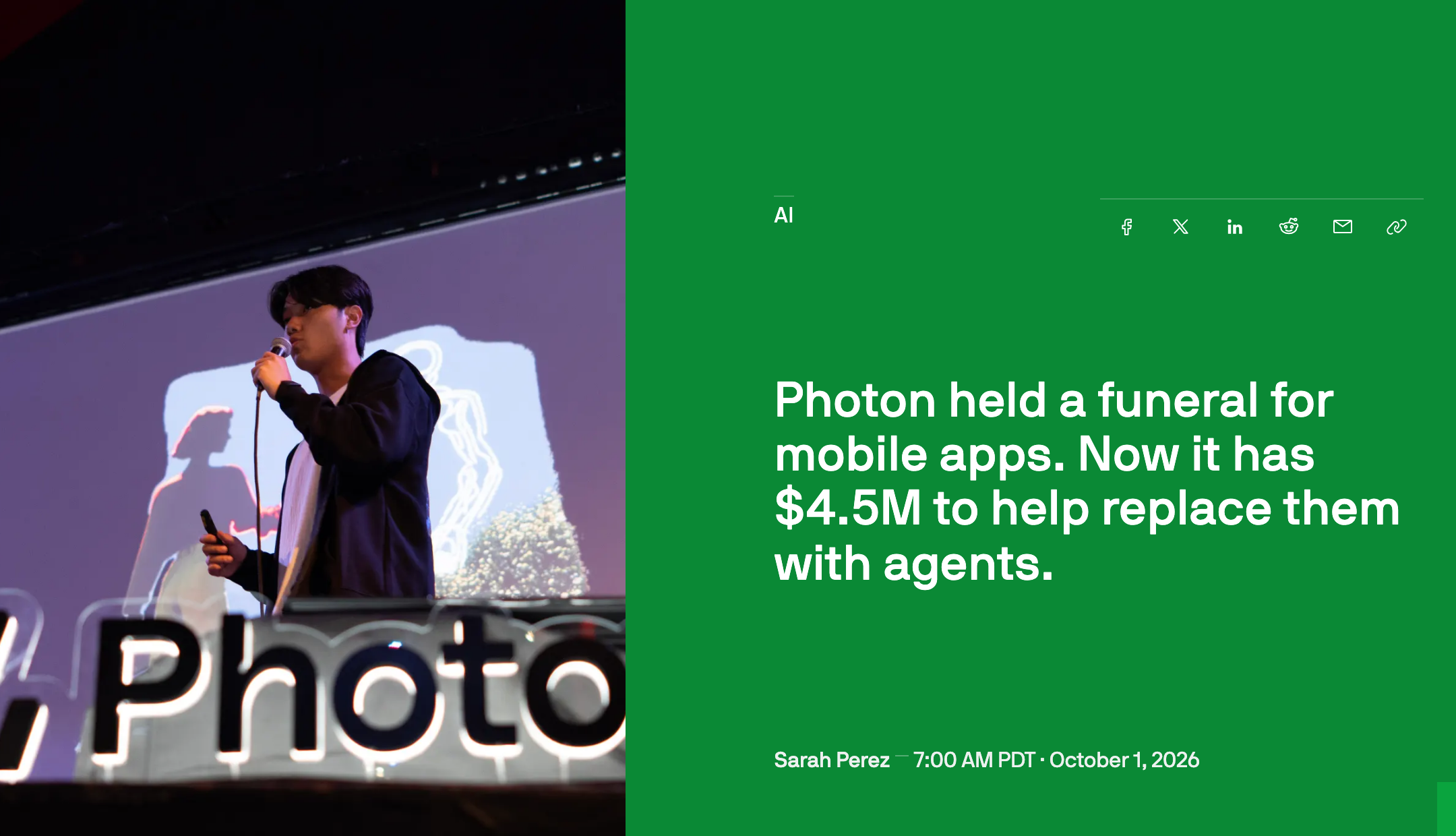
the objection you hear most in your first pitches is worth writing down
ours was one sentence: "i have ChatGPT, that's enough"
it was not a stupid objection. most AI products were chat windows then
explaining harder did not fix it. what changed minds was other ppl building agents into messaging all through 2026
we announced a $4.5M seed for @photonhq in october. i do not think we got better at pitching. the idea just stopped being strange
if you are hearing "why would anyone need this", check one thing: are users pulling the product out of your hands anyway
what investors said about my company, by year:
- 2025: "what do you mean by that?"
- 2025: "i have ChatGPT, that's enough"
- 2026: a $4.5M seed round, and 436K downloads a month on our SDK
the pitch barely changed. agents that live in your messages, no app to open
the developers using Photon got it long before the investors did. if the ppl closest to the problem understand you, keep going
Never mention Twilio
The Twilio story retold: told not to mention them, did anyway, because of a DevRel at your first hackathon.
investor friends told me to NEVER mention Twilio in our pitch
i did anyway
Twilio is the company developers have used for years to send texts from their apps
it gets a lot of hate online, and the advice was to stay far from the comparison
but at my first hackathon, someone from Twilio came to my table to help me. i was in middle school, nowhere near being a customer
they helped me like they would help anyone. it is a big part of why i wanted to build tools for developers at all
so when ppl ask what Photon is, i say it: we are basically Twilio for AI agents
the best developer marketing i ever saw was aimed at a middle schooler
i was the middle schooler. it was my first hackathon, and someone from Twilio walked over to help with my project
i was years away from being a customer. they helped anyway
i have remembered that company's name ever since, and i defended them when hating on them got popular
it is why @photonhq sponsors hackathons and is free to start. you never know which kid at which table builds a company in your space
things investors told me not to say in my company's pitch:
- Twilio
things i said in the pitch:
- Twilio
their team helped me at my first hackathon, when i was in middle school and nobody's customer. i was not going to hide who showed us the way
Side project to conviction
Photon began as a side project and conviction came later, as OpenClaw, Hermes and others moved to messaging.
i started my company without any conviction that it would work
it was a fun side project. my co-founder Ryan and i built a way to get an AI agent into a text thread
we open sourced it in october 2025. developers picked it up, which was nice. i still did not think of it as my life's work
the conviction came from outside. early in 2026 an open source agent called OpenClaw made messaging its main interface. then Hermes Agent did. then a wave of consumer agents
we had not moved. the market walked over to where we were standing
by the time Photon launched a paid product in april, i was certain
if you do not feel certain yet, ship it and watch who shows up
you do not need conviction to start a company. it can arrive later
here is how mine was built:
- october 2025: we open source a side project
- early 2026: OpenClaw moves to messaging
- soon after: Hermes Agent does too
- then: consumer agents become phone numbers
each step was another AI agent team proving our thesis for us. by spring that side project was @photonhq, a product ppl pay for
founders hide this part because certainty makes a better story
what being early looked like for my company:
- oct 2025: we open source a side project that puts AI agents in iMessage
- late 2025: investors tell us "i have ChatGPT, that's enough"
- early 2026: a popular open source agent moves to messaging
- then: Hermes Agent does too, and a wave of consumer agents follows
- today: Photon, 436K downloads a month and a $4.5M seed
it was the same repo the whole time. trust the process
What Photon was before iMessage
Before iMessage there was Photon Framework, a general agent toolkit. The small sharp tool won.
the product that became my company was one small module in a bigger plan
a year ago we were called Photon Framework. the tagline was "Agent Dev. Reimagined."
the plan was a general toolkit for building AI agents. a connector for apps and devices, a kit for prototyping, all of agent development at once
inside it was one small piece that let an agent send and receive iMessages
when we open sourced everything in october 2025, that piece is what ppl cared about. it is the part developers used and sent fixes for
so we followed the pull. the framework faded and the messaging piece became the company
the ambitious version is tempting. the market usually picks the small sharp thing that solves one problem completely
if you are building a platform, watch which single feature ppl keep using
our first idea was huge: a framework to reimagine how AI agents get built
our second idea was tiny. a module that got an agent into iMessage. we did not even think of it as an idea
the big one got polite interest. the small one got strangers using it and sending us fixes
a general toolkit competes with everything. a specific tool competes with almost nothing
so we built Photon around the small one
scroll far enough back and my company has a name we dropped: Photon Framework
it was going to be tools for every part of building an AI agent
messaging was one line on the list. it was also the only line ppl used
we kept that line and let the rest go
The first dollar
The first revenue.
the first money my company ever made was a couple hundred dollars
it came from strangers, about a year before we raised a seed round
my co-founder Ryan and i had open sourced our project. it was free, and we had no plan to charge for anything
then ppl started paying us for the service. a couple hundred dollars in total. not even that much
but i had spent years building projects nobody used, let alone paid for. this was the first time a stranger decided our work was worth money
it was enough evidence for me to leave school and build Photon full time
i still think of it as the most important money we have received, because it had to be earned from zero
your first revenue is not income. it is information
ours was a couple hundred dollars, and it told us three things:
- ppl paid, even though the code was free
- the buyers were strangers, not friends being kind
- years of unused side projects had finally ended
that small amount is why @photonhq exists as a company
if you are early, chase that answer first and do not worry about the size
revenue from things i built, in order:
- years of hackathon projects: a few prizes, zero customers
- our open source project, first weeks: a couple hundred dollars from strangers
- Photon, one year later: a $4.5M seed and 436K downloads a month
the couple hundred is the one i remember. it was the first time someone i had never met paid for our work
How the seed came together
The story of the seed round.
we raised a $4.5M seed on an idea investors first told us nobody needed
the idea was that AI agents should live in your messages. the reply we heard most early on was "i have ChatGPT, that's enough"
you cannot argue someone out of that in a meeting
so we went back to building. we kept the product free to try, and developers kept arriving
in april we launched the managed version of Photon that ppl pay for. over the same months, the market moved toward messaging agents on its own
by the time the round came together, we were showing usage and not an idea
it was co-led by Gradient and A*. my only real lesson about raising money is that the round follows the product
the fastest way to raise money is to stop pitching for a while
that is roughly how the seed round for @photonhq came together
- early no's are about timing more than you
- our pitch barely changed. the product did
- the market did some of the work in 2026
i am grateful to everyone who backed us, and i hold nothing against the ones who passed early
if i raised again, i would spend the first months on usage and let the meetings come second
about a year ago i posted that it was all about closing the round
update: we closed it
it took a lot longer than the me who wrote that post expected. we had to go build the proof first
the old post makes it look like i knew what i was doing. i did not. i kept working on Photon until the round stopped being the hard part
Year one
One year, then and now: first commit to a seed round, a full room and a funeral for apps.
one year ago my company was a single commit in an open source repo
my co-founder Ryan and i were students in two different cities
then we moved to San Francisco and lived in a motel next to the airport, because it was the cheapest option we could find
the months after were not dramatic. we shipped, developers tried it, we fixed things, and we shipped again
we gave the product away for about six months, then launched a paid version in the spring
this fall Photon announced a seed round and hosted its first developer day. hundreds of developers came, and we held a funeral for 67 apps
there was never a week where it turned. you keep shipping and one day the room is full
my company's first year, in receipts:
- a motel room by the airport, because it was the cheapest option
- a $1,000 wire i announced like a funding round
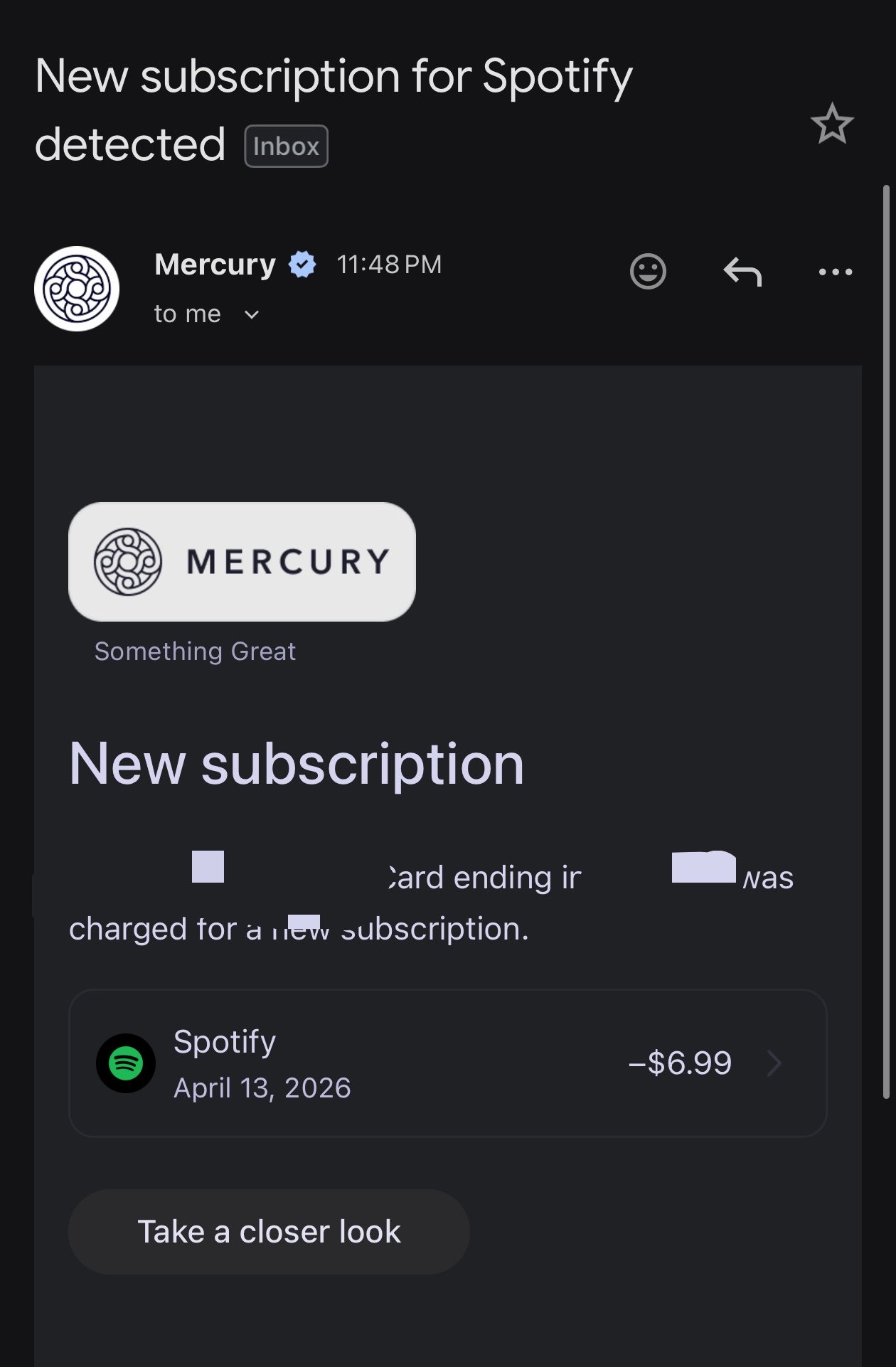
- a company card charged for music, with a student discount
- four laptops i called interns
- Photon today: 436K downloads a month, 1.67M views on one launch, a $4.5M seed
there was never one week where it turned. we kept shipping and one day the room was full
one year is all it takes to change your life around
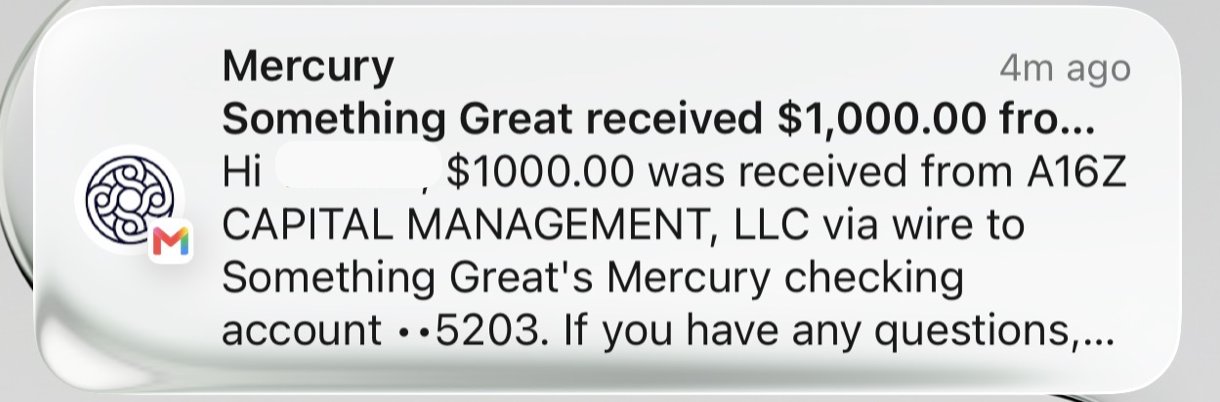

a year ago Photon was a github repo. technically it still is
the repo did not change much. the ppl using it did
back then it was a few curious developers. now it sits under AI agents that ppl text every day
if you are at the repo stage with no proof yet, it looks exactly like this at the start
Building and engineering
7 postsRouting rebuild
The July routing rebuild told as a founder's bad week, not a root cause.
we deleted 5,200 lines of our own code while customers were using it
it was the hardest call we made at @photonhq this year
developers send us a message and we deliver it to someone's iMessage. for a long time we treated "accepted" and "delivered" as one step
as volume grew, the two drifted apart. some messages were accepted and did not arrive the way we wanted
from the outside everything looked fine, which is the dangerous part
so this summer we stopped patching and rebuilt the routing. my co-founder Ryan, our CTO, led it
we moved from Bun to Node and added a Postgres event log, so every message has a history
accepting a request and delivering a message are two different jobs. we rebuilt around the second one
"accepted" is not "delivered". 4 things we changed after learning that:
-
we count success when the message lands, not when we accept the request
-
every message now has a history we can read back, in a Postgres event log
-
we moved the runtime from Bun to Node, which is easier to reason about under load
-
we deleted about 5,200 lines of old fixes
this was the july rebuild of the shared iMessage lines most developers start on at Photon
nobody outside noticed, which was the goal. my co-founder made the technical call and i would back it again
there is one sentence i stopped trusting this year: "your request was accepted"
accepted is easy. delivered is the job
in july we rebuilt our message routing around that difference, and removed around 5,200 lines of old code
now when a developer asks what happened to a message, we answer with a record
How Photon powers the best iMessage agents
What sits under the agents people already text, and what the best ones have in common.
some of the AI agents ppl use every day do not have an app
the whole product is a phone number you text
we run the messaging under a lot of them at @photonhq, so we see what the good ones share
matchmaking agents, money agents, email agents. different products, same pattern
there is nothing to download. you text a number and you are in
the person sends the first message, so the agent is invited into the conversation
the agent acts like a contact. it reacts, shows typing and replies in the same thread
and none of these teams run their own messaging setup. they build on us and spend that time on the agent
the agent gets the credit. we make sure the text shows up
the iMessage agents that grow have 4 things in common. none is the model
-
the user sends the first message
-
onboarding is one text. no app store, no sign-up form
-
the agent acts like a person. it reacts, shows typing and replies in place
-
the team does not run the messaging layer themselves
i see this from underneath, because many of the consumer agents ppl text run on Photon
if your agent still lives in a web chat, start with number 2. it is the cheapest change and usually the biggest
building the AI agent is the easy half
keeping a messaging service running day and night is the other half, and most teams never want to see it
machines have to stay up for weeks without anyone touching them. things break that never break in a normal app
we run that part so developers never have to. they write the agent once and the texts go out
daniel_t·Articleyou have probably texted an AI agent by now. maybe it helped you book something, or reminded you about something, or just answered a question in the same app where you text your friends
most ppl never think about what is under that conversation. i think about it all day
i'm Daniel, the co-founder of Photon. we build the infrastructure that lets AI agents live inside iMessage and other messaging apps. a developer writes the agent, and we give it a phone number and make sure the messages go in and out. many of the consumer agents you have heard of run on our infrastructure, so i get to see what the good ones do differently
tldr: the best agents have 5 things in common, and none of them is the model
i am not going to name companies here, because their numbers are theirs to share. but the patterns are the same across all of them, and you can copy every one
1. the product is a phone number
the strongest agents we work with do not have an app. some of them do not even have much of a website. the whole product is one number you text
i have seen a team build a matchmaking product for students this way, and a team that lets ppl move money this way. you would expect products like that to need an app with screens and settings. they decided they did not, and their users never asked for one
the reason this works is onboarding. think about what a normal app asks of you. find it in a store, download it, make an account, verify your email, allow notifications, sit through a tutorial. every one of those steps loses ppl
with a number, the first step is a text. you send "hey" and you are inside the product. text a number to get started is the best onboarding method i know, and i have not seen anything beat it
2. the user texts first
this one sounds like a small detail and it decides almost everything
the agents that last let the person start the conversation. someone hears about the agent, texts it, and the agent replies. it is an opt-in system by default, and nobody feels ambushed
the agents that struggle do the opposite. they get a list of numbers and start sending messages. even when the message is useful, it arrives in the one inbox ppl still protect. your messages are where your family and your closest friends are. an agent that shows up there uninvited is spam with a personality
we tell every developer the same thing. let ppl come to you, keep the first reply simple, and care about response rate more than volume. an agent that 100 ppl reply to is worth more than one that reaches 10,000 ppl who ignore it
3. it behaves like a contact
before Photon existed, i built a clone of myself as a side project and connected it to my own phone number. for a while, anyone who texted me was texting the agent. most of them did not notice
i would love to say that was because the writing was so good. it was not. the agent reacted to messages. it sent pictures. it sat in the same thread where they had always talked to me, under my name
that taught me how ppl really judge an agent. they do not grade the sentences. they notice whether it acts like someone who belongs in their messages
the best agents on our platform use everything a person would use:
- a tapback on your message before the real answer comes
- typing dots while the model is working
- replies the length of a text, not the length of an email
- a contact card, so they show up in your phone with a name and a photo
ppl trust a thumbs up more than a paragraph. it is a strange thing to learn from running infrastructure, but we see it every week
4. it does one job
almost every agent that does well with us can be described in one sentence. it finds you a date. it moves your money. it handles your email. it answers questions about one store
the ones that try to do everything have a harder time, and i think the reason is trust. i trust someone to handle my company financials. that does not mean i trust that same person to book my travel. ppl give trust one task at a time, to ppl and to software
a narrow agent only has to earn trust once, for one thing. when it does that thing well a few times, you stop checking its work. a general agent has to earn it again for every new task, and most ppl run out of patience first
5. the team never thinks about delivery
this is the part we do, so i will keep it short
accepting a request and delivering a message are two different things. it is easy to build a system that says "ok, got it" when your agent sends a reply. it is much harder to make sure that reply shows up on someone's phone, in order, every time, at any hour
we learned the difference the hard way. this summer we rebuilt how messages are routed on our shared lines and deleted about 5,200 lines of our own code doing it. there were some bad days in there
the point for an agent team is that none of that should be their problem. the best teams we work with spend their time on what the agent says and does. they write the agent once and never think about what is running underneath. that is exactly how it should be, and it is the reason our company exists
what kills the other ones
i wrote this once and i still believe it. 99% of personal agents will die in one month. the ones that survive won't be the smartest. they will be the ones that reach you and remember you
every dead agent i have looked at made the same mistake. it expected you to come to it. it lived in an app or a browser tab, and it waited. i have watched too many great agents die in web chat while their users lived in their messages
if you are building one
here is the short version of everything above:
- make the number the product, and delete every step before the first text
- let the user text first
- react, type and reply like a person would
- pick one job and be the best at it
- do not build the delivery layer yourself
none of this needs a bigger model or a bigger team. the agents doing these 5 things are often two or three ppl
if you are working on one and want to put it in iMessage, Photon is free to start, and you can run your first agent in a few minutes
Beliefs and category
23 postsStop building general agents unless you are a lab
Labs should build the general agent; everyone else should pick one job. Labs are named as the right owners, not as losers.
unless you are a research lab, stop building a general AI assistant
i say that as someone who wants you to win
OpenAI, Anthropic, Google and Meta are all building one, and they should. they train the models and they have the compute and the distribution
so my question to small teams is always the same: why would you build a ChatGPT 3.5 competitor?
a lot of agent companies come through @photonhq, and the ones ppl keep texting are narrow
one job, done well enough that someone texts it again tomorrow
that team knows the job better than any lab ever will. a lab cannot copy that
pick the job first. the labs will hand you a better model every few months
the general AI agent already has 4 owners, and you know their names
OpenAI, Anthropic, Google and Meta will each ship one. they are the right ppl to do it
if you build one too, you are racing the companies that train the model you rent
what i see working is the opposite. ppl give one agent one job and see how it goes
"text this number and it does X" spreads by word of mouth. "it can do anything" does not
it is the bet we made at Photon too. we do not build agents. we do one job, getting them to the person
i ask almost every agent founder the same question
why would you build a ChatGPT 3.5 competitor?
the labs have the models, the money and the users. a general assistant from a small startup is last year's capability with a nicer landing page
the founders who do well answer with one job and one person
daniel_t·Articlethere is a certain kind of pitch i hear almost every week now. a small team, usually very talented, tells me they are building an AI assistant that does everything for you. your email, your calendar, your shopping, your travel, your money
i always ask the same question back. unless you are a research lab, why would you build a ChatGPT competitor?
i'm Daniel, the co-founder of Photon. we build the messaging infrastructure for AI agents, which means that when a company wants its agent to live in iMessage or another messaging app, a lot of the time it runs through us. so i see many agent companies up close. i see what ppl still use after the first week, and what they forget
tldr: the labs are going to build the general agent. everyone else should pick one job and be the best in the world at it
the labs own the general agent, and they should
OpenAI, Anthropic, Google and Meta are all building an agent that can do anything. i think that is the right thing for them to build. they train the models. they have the compute. they have hundreds of millions of ppl already opening their products every day
a general agent is the natural product of a company that owns a general model. each time the model gets better, their agent gets better at everything at once
now look at it from the side of a startup. you are renting the model from one of those four companies. your product is their model plus your prompt plus your interface. if what you sell is "an agent that does everything", you are selling the exact thing your supplier is building, with less data, less money and a model you do not control
i have a lot of respect for ambitious founders, and i do not enjoy saying this to them. but if your product can be described as "like that, but ours", you are in a race against the companies that make the thing you are renting
general is the wrong shape for trust
there is a second reason, and it has nothing to do with competition
I trust someone to handle my company financials. that does not mean I trust that person to book a travel plan for me. those are different kinds of trust, and i give them to different ppl
most of us live this way without thinking about it. you have a doctor. you have someone who does your taxes. you have a friend whose restaurant picks you never question. none of them is the same person, and you would find it strange if one person asked to do all three on the day you met them
agents work the same way. an agent that moves your money has to earn your trust on money, one transfer at a time. an agent that books your flights has to earn it on flights. being great at one does not carry over to the other
a general agent asks for every kind of trust on day one, before it has earned any. a narrow agent asks for one kind, and gets the chance to prove itself. that is a much easier thing to say yes to
what the survivors look like
from where i sit, the agents that are still growing a few months after launch are almost all narrow
i will keep them unnamed, but here is the kind of thing i mean. one agent does matchmaking for students and nothing else. one helps you move money by sending a text. one only handles your inbox and messages you when something needs you. one answers questions for a single brand
you can describe each of them in a sentence, and that sentence is also their marketing. nobody has to explain what they are for
they also tend to be small teams. they do not need to be good at everything, so all of their work goes into one job. when the labs ship a better model, these teams do not get replaced. their one job just gets done better
the two mistakes i see most
the first mistake is building the general assistant and hoping a use case shows up later. it usually does not. ppl try it, think it is impressive, and cannot remember a week later what they were supposed to use it for
the second mistake is making ppl download something to reach it. if your agent requires a download, you've already lost. apps are having a hard time getting installed at all right now, and a new assistant app is competing with every other icon on the phone
the two mistakes stack. an agent with no clear job, living in an app nobody opens, is the most common thing i see fail
this is the reason we built Photon the way we did. we wanted an agent to be something you text, in the place where you already talk to ppl, and we wanted any company to be able to have its own
what i think actually happens
i do not think the general agents lose. a few companies will win the front door, and most ppl will have one general agent they like
my bet is on a mixed world. behind that front door there will be thousands of agents that each do one thing, made by ppl who understand that one thing better than any lab ever will. a lab is never going to care about your niche as much as you do
every brand and every platform should be able to have its own agent. and your general agent should be able to find those agents, talk to them, and work with them, with you in the conversation
if you are starting an agent company today
this is what i would tell a friend:
- write down the one job. if it takes more than a sentence, it is two products
- pick a job where trust matters, because trust is the thing a lab cannot ship for you
- meet ppl where they already are. do not make them download anything
- let the labs improve your product for free. every model release should make your one job better
- be okay with it taking 10 minutes to explain at first. the non-consensus ideas always do
the general agent race has four or five real entrants, and you already know their names. the good news is that almost everything else is still open
Trust is per task
Trust does not transfer between tasks, so one super agent will not own everything. Short form of your Nov 5 article.
one AI agent is not going to do everything for you
and it has nothing to do with how smart the models get
i trust someone to handle my company financials. that does not mean i trust the same person to book my travel
agents work the same way. you try one on a single thing. if it does that well a few times, you give it a little more
we are the messaging layer under a lot of consumer agents at @photonhq. the ones ppl keep texting own one task
nobody hands a new agent their money, calendar and inbox on day one
my bet is many agents, each trusted for its own job. the long version is in the article below
trust does not transfer between tasks
a good restaurant pick does not make you hand over your bank login
here is what ppl actually do with agents. they start with one small job where a mistake costs nothing
when the agent gets it right a few times, they come back for that same job
for a second job, they are just as happy to text a different agent known for it
it is how you treat ppl. you have a doctor, an accountant and a friend who knows where to eat
so you do not need to build everything. be the one ppl trust for your thing. Photon handles being easy to reach
would you let your accountant plan your honeymoon?
probably not, and it is no insult to your accountant. you trust them for one thing because you have seen them do it
agents will work the same way. a handful in your messages, each earning its place like a person does
Agents should talk in front of you
A2A2P: agents and people in the same conversation.
agents should talk to each other, but not behind our backs
the popular picture is your agent calls my agent, they work it out, and we hear about it after
that leaves out the most important person, which is you
maybe they booked the wrong day. maybe one shared something you would not have. you were not there to say wait
so when we built agent to agent at Photon, we put it in a group chat. the agents talk, and you can read every message and step in
i call it A2A2P - agents and people in the same thread
fully automatic is not ready yet. nobody knows how much an agent should do before it stops and asks you
nobody knows how much an AI agent should do before it asks you
anyone who says they do is guessing. we had to face that when we shipped agents that can bring other agents into an iMessage group chat
the useful part is real. a booking agent and a payments agent can finish a task neither could do alone
the risky part is the handoff nobody sees. you hear about it when it is already done
a group chat fixes most of that, because everyone is in one thread
start with the conversation visible. you can remove the human from a step later. adding them back is much harder
nobody wants to find out what their AI agent agreed to yesterday
that is my whole problem with agents talking to agents in private
put them in the group chat. let them talk where you can scroll back and jump in
you stay in control without doing the work
The download is the cost
If your agent needs a download you have already lost.
if your agent requires a download, you have already lost
i learned it by losing. before Photon i built a lot of small apps at hackathons, and some won prizes
almost none were opened again after the weekend. they were not bad
nobody was going to visit a store, wait for an install, make an account and then remember the thing existed
it is harder now. AI made apps cheap to build, so far more of them are fighting for the same home screen
meanwhile everyone already opens their messages all day without being asked
that is why we built Photon so the first step is a text. the agent answers while the person still cares
the most expensive step in your funnel is "get the app"
open the store, install, sign up, verify, allow notifications. every one is a place where a curious person gives up
building got cheap. attention did not
an app has to earn its way back onto your screen every day. a text thread is already where you look
and the first reply is the demo. someone texts an agent, it answers, they get it
count the steps between a stranger and their first useful answer. then ask how many you really need
it is the count we care most about at @photonhq
count the new apps you downloaded this year and still use
now count the phone numbers you texted
the first number is tiny. the second is too big to count
that gap is why my company gives AI agents a phone number
Why personal agents die in a month
Reach and memory decide which personal agents survive. Your insider view from the infrastructure seat.
99% of personal AI agents will die within a month of launching
and it will not be because they were not smart enough
it starts well. the demo impresses, ppl sign up, and for a few days they try everything
then normal life comes back. the agent lives in an app or a tab, and you have to remember it exists
by week three most ppl have stopped opening it. the model did not get worse. they forgot
the survivors do two things. they reach you where you already look every day, and they remember you
we work with a lot of teams building these at @photonhq. we handle the reach, so they can spend their time on the memory
how a personal AI agent dies, week by week:
week 1: ppl are impressed and show a friend
week 2: they use it when they think of it
week 3: it is one more app they mean to get back to
week 4: they have moved on to the next one
the ones that live sit where you already are, and they remember what you told them
i've watched too many great agents die in web chat while their users lived on iMessage and WhatsApp. it is the reason we built Photon
if retention falls off after week one, look at where the agent lives before you touch the prompt
i have a folder of AI agents i used for one week
none of them were bad. using them just meant going somewhere
a contact remembers you. a tool starts over
that is why the agents that live in your messages are the ones that last
daniel_t·Articleevery few weeks a new personal AI agent launches and everyone gets excited. it has better memory, better tools, better reasoning. ppl try it, post about it, tell a friend
and then most of them never touch it again
i have done this too. i have a folder of agents on my phone that i was sure would change my life, and i could not tell you the last time i opened any of them
i'm Daniel, the co-founder of Photon. we build the infrastructure that lets AI agents live in iMessage and other messaging apps, so a company can give its agent a number that ppl text. it means i see a lot of personal agents from underneath, at launch and again a month later, and the gap between those two moments is what this article is about
tldr: the agents that survive won't be the smartest. they will be the ones that reach you and remember you
how an agent dies
it almost never ends with someone deleting it. it looks like this
on day 1 you are impressed. the agent books something, or summarizes something, or just talks in a way that feels new. you tell someone about it
by day 7 you have to remember it exists. it lives in an app on your third home screen, or in a browser tab you closed. you think of it once or twice, usually when you are busy with something else
by day 30 you have not opened it in two weeks. nobody uninstalls anything. it just stops being part of your life
what gets me about this is that the model did not get worse in those 30 days. the agent was exactly as capable on day 30 as on day 1. the product did not fail at intelligence. you forgot it was there
when i started seeing this over and over, i tried to work out what the survivors do differently. it comes down to three things
reason 1: it expects you to come to it
almost every agent that dies makes the same mistake. it expects you to go to it, through an app or a tab
that sounds reasonable, because it is how software has always worked. but an agent is supposed to save you effort, and the first thing these agents do is add a new habit to your day. open the app, remember what you wanted, type it in
i've watched too many great agents die in web chat while their users lived in iMessage and WhatsApp. the agent was good. it was just in the wrong room
this is the whole reason i care about messaging. we did not pick it because it is clever. it is the one surface almost everyone already knows how to use. you check your messages many times a day without deciding to. an agent that lives there does not need you to form a habit, because the habit already exists
i found this out by accident before Photon was a company. i built a clone of myself as a side project. it started as a website and nobody visited. then i connected it to my own phone number, and suddenly everyone who texted me was using it. same agent, completely different result, and the only thing i changed was where it lived
reason 2: it does not remember you
the second time you talk to an agent, it should know the first time happened
think about what makes a contact in your phone different from a tool. when you text a friend, you do not introduce yourself again. they know what you talked about last week. they know your job, your plans, the thing you were worried about
a lot of agents start from zero every time, or remember facts in a way that feels like a database and not like a person. you end up explaining yourself again, and at that point it is easier to just do the task yourself
the agents that last feel like they are in an ongoing conversation with you. a thread in your messages helps with that more than ppl expect, because the history is right there for both of you. you scroll up and it is all in one place
i think of it this way. a contact remembers. a tool starts over. ppl stay loyal to contacts
reason 3: it is trying to be everything
the third reason is about trust
I trust someone to handle my company financials. that does not mean I trust that same person to plan my travel. trust is given per task, and it is earned slowly
a personal agent that wants to run your money, your trips and your inbox is asking for three different kinds of trust on the first day. most ppl respond by giving it none of the important work. they ask it trivia, get bored, and leave
the agents i see doing well picked one job. because the job is narrow, you can tell quickly whether they are good at it. once they prove it a few times, you stop double checking, and that is the moment an agent becomes part of your life
what survival looks like
when i put the three together, the surviving agent looks almost boring
it is in your messages, so you did not download anything and you never have to remember to open it. it knows what you said last week. it does one thing you care about, and it does it the same way every time
it also behaves like it belongs there. it reacts to your message, it shows that it is typing, it replies in a sentence or two. none of that is impressive in a demo. all of it matters in week 4
i would love to give you exact retention numbers here, but those belong to the companies building these agents, so i will just say that the difference between the two groups is not small
the test i use
when a founder shows me their agent, i ask one question. do your users have to remember to open it?
if the answer is yes, i think they have about a month. it does not matter how good the model is, because the product depends on a habit ppl are not going to form
if the answer is no, because the agent is already somewhere they look every day and it already knows them, then they have a real chance
so if you are building a personal agent right now, i would spend less time on making it smarter and more time on two things: how it reaches ppl and what it remembers about them. those two decide who is still around next month. it is what we work on at Photon every day, and it is the bet the whole company is built on
If it takes 10 minutes to explain, keep going
Non-consensus ideas take 10 minutes to explain, and that is fine. Uses your own Luma poll.
i asked a room at my own event "what does Photon do?"
one guest answered "optimized ml pipelines"
that is not even close. we put AI agents into iMessage. this person came to our event and still had no idea
it was not the first time. early investors would stop me and say "i have ChatGPT, that's enough"
it took me about 10 minutes every time to explain what i meant
for a while i thought that meant something was wrong. now i think the opposite
if everyone nods at your one sentence pitch, a lot of ppl are already building it. the ideas that take 10 minutes are the non-consensus ones
so we kept explaining. the room gets it a little faster every month
if it takes you 10 minutes to explain your startup, keep going
early investors heard our pitch and said "i have ChatGPT, that's enough"
a guest at our own event answered a poll about what we do with "optimized ml pipelines"
being hard to explain and being wrong are different things. easy pitches are easy because everyone already agrees, which usually means crowded
the test i use now is whether ppl get it after they try it. someone texts an agent on @photonhq once and understands
so make it possible to try. that explains it faster than you can
for months i thought i was bad at explaining my own company
then other teams started putting agents into messaging, and the same explanation started landing
the idea had not changed. ppl had finally seen enough to have somewhere to put it
non-consensus sounds confusing at first. that is part of why it is still open
Text-a-number is the best onboarding
No app store, no form: texting a number as the best onboarding there is.
the best onboarding i have ever seen is someone sending a text
think about what a normal product asks first. find it in the app store, download, type your email, wait for a code, pick a password
a little of your interest leaks out at every step
now compare texting a number. you send "hey" and the agent answers. you are already using the product
there was no tutorial, because everyone knows how to text
i said a while ago that text a number to get started is the best onboarding method. the more agents i see launch on Photon, the more i believe it
ask how much of your onboarding exists for you, and how much exists for them
want more ppl to finish your onboarding? delete it
that is what happens when an AI agent has a phone number. here is what goes away
the app store. nobody has to search, install or update
the sign-up form and the tutorial. texting needs no explanation
what is left is the first useful answer, in the person's own words
some of the best consumer AI companies we work with at @photonhq grew this way
their sign up is a first message, and a friend passes it on by sharing a contact
could your grandpa start using your product without calling you for help?
most apps fail that test. a text does not. he already knows how to send one
it is the idea Photon is built on. give the agent a number, and starting feels like messaging a new friend
Company building
16 postsWe only hire people who coded before GPT
The hiring rule you gave on our call. Strongest opinion in the batch and it will draw replies.
at my company @photonhq, we only hire engineers who learned to code before ChatGPT existed
ppl argue with me every time i say it, so here is where it comes from
everyone on our team codes with AI all day. we give the whole team unlimited Cursor, Claude Code and Manus
but AI tools are at their best when you already know what correct looks like. you feel something is off before you can say why
that feeling comes from years of breaking things by hand
for us a small mistake means someone's message does not arrive. when the agent is confidently wrong, somebody has to catch it
someone who started after GPT can build a lot, fast, and that is great
for now we hire the ppl who built that instinct the slow way. there will be fewer and fewer of them
the most valuable skill on our team is knowing when the AI is wrong
it is behind a hiring rule that sounds harsh: we only hire ppl who knew how to code before GPT
AI is good. we use it everywhere, and it lets way more ppl build
but building and debugging are different skills. AI made the first one easy
in infrastructure like ours at @photonhq, the expensive bugs are quiet. the code runs, the tests pass, and something is still wrong
you only catch that if you have been burned before
it is not fair to every individual. for a small team where each hire carries a lot, it is our filter for now
one interview question: what did you build before AI could build it?
the tools are only as good as the person checking the result
so for now we only hire ppl who learned to code before GPT. there are going to be less and less of them
daniel_t·Articlethere is a new kind of software engineer who has never written a program without an AI assistant, and a lot of companies are about to find out whether that matters. we already made our call. at my company, we only hire ppl who knew how to code before GPT
i'm Daniel, the co-founder of Photon. we build messaging infrastructure for AI agents, which means we run the systems that let an agent send and receive real texts in iMessage and other apps. when our code is wrong, a message does not arrive, and somebody's product looks broken in front of their users
i want to explain the rule properly, because said in one line it sounds like i am against AI. i am not. our whole company exists because of it
tldr: AI is good, and it lets far more ppl build. it also creates fewer developers, meaning ppl who understand what is happening underneath. we hire for that understanding, and the simplest signal we have found is whether someone learned to code before the tools could do it for them
where i am coming from
i started coding in middle school, about ten years ago. i learned from YouTube, Stack Overflow and online courses, and i spent most of my teens at hackathons building things that broke at 3am with nobody around to ask
it was slow, and it was often miserable. you would spend six hours on a bug that turned out to be one wrong character. but those hours are where i learned how a system fits together, because i had to trace every piece of it myself
then in college i did internships in research and finance, and i watched tools start doing in an hour or two what had taken me two days. i remember being scared by it. i could see that a lot of entry level work was about to disappear, including the work i was being trained for
so i have been on both sides of this. i learned the slow way, and i watched the slow way stop being required
AI made more ppl who can build
the good part first, because it is really good
AI gives many more ppl the ability to build. someone with an idea and no training can now make a working website in an afternoon. students today probably build a website before they step into their first CS class. i think that is great. more ppl making things is how we get more good things
it also changes what code is. with a tool like Claude Code, writing code is basically no code. you describe what you want and you get it
our team lives in these tools. everyone at Photon gets unlimited Cursor, Claude Code and Manus, and nobody has to ask for permission to use them. if a tool makes someone faster and i make them fill out a form for it, i am the bottleneck
and fewer developers
here is the other half. the same tools that make more ppl able to build also create fewer developers
by developer i mean someone who knows what the machine is doing when the code runs. someone who can look at output that seems fine and feel that something is off
an AI assistant will write you five hundred lines that work in the demo. the question in our business is what happens on the bad day, when messages are being accepted by the system and not delivered, and the dashboard is green. the assistant does not know. it will happily suggest a fix that makes the dashboard greener
on that day you need a person who has been lost inside a system before and found their way out without help. ppl who learned before GPT had no choice about getting that experience. ppl who learned after can skip it, and many do, through no fault of their own
there are going to be less and less of the first group. that is exactly why we want them
how the rule works in practice
the question we care about in an interview is simple: what did you build before the AI could build it for you
we are not looking for a date on a resume. we are listening for the story. a real one has a part where everything broke, a part where the person did not know why, and a part where they figured it out by reading something nobody wanted to read
then we want to see how they use AI now. the best engineers we know use it constantly and trust it carefully. they let the agent write the first version and then they read it the way you read a contract
i hold our own product to the same idea from the other direction. before a release of our SDK goes out, i hand it to a coding agent and ask it to build something from nothing. our goal is that it works at least 80% of the time. the agent is now a real user of our product, and somebody on the team has to understand why it fails the other 20%
where this breaks
i know the objections, and some of them are fair
it is a blunt rule. there are ppl who started coding last year and went deeper than someone with ten years of habit. a year on a resume does not measure curiosity, and we would be wrong to pretend it does
it also has an expiry date. every year there are fewer ppl who learned before the tools, and at some point "before GPT" will describe almost nobody under 30. we will need a better test, and i think the better test is the interview question, not the date
and it leaves a real problem unsolved. if companies stop giving entry level work to juniors, where do the next senior engineers come from? i do not have a clean answer. i only know that for a small team running infrastructure, we cannot be the place where someone learns the fundamentals for the first time
what i would tell someone learning now
if you are learning to code today, use the AI tools. you would be foolish not to
but once in a while, turn them off and build something small the slow way. get stuck. stay stuck for a few hours. read the error instead of pasting it
the ppl who can do both are going to be rare, and every company building serious software is going to be looking for them. we already are
More builders, fewer developers
AI lets more people build and makes real developers rarer. The softer version of the hiring take; can run first.
AI made a lot more ppl who can build, and fewer developers
i see both sides every week, because we sell to ppl building with AI and we hire engineers
the first side is wonderful. a student today has probably built a website before their first computer science class
when i started about 10 years ago, getting anything on a screen took weeks of confusion
the hiring side is harder. when we look for someone to work on the deep parts of Photon, the pool is small
if a tool always gives you the answer, you get fewer chances to learn why it works
so understanding what is underneath is becoming rare, and rare skills get valuable. use AI for everything, and still read what it wrote
everyone can build now. fewer ppl can debug
if you are early in your career, the second half is your opportunity
the floor went way up. someone with an idea and a weekend can ship something real
but ppl used to learn by getting stuck for days. now you get unstuck in a minute
the gap shows up later, when something breaks in a way the tool cannot explain
that person is getting harder to find. we feel it every time we hire at @photonhq, and our whole team codes with AI all day
the ppl who can build fast and explain why it works will be very hard to replace
i once said that with Claude Code, code is basically no code
i still mean it as a good thing. someone starting today will build more in a month than i did in a year
but the slow part is where developers used to be made, and fewer ppl go through it now
so keep the tools. every so often, turn them off and understand one piece yourself
Two technical co-founders
Both technical, and Ryan has the final call on tech.
i lose technical arguments at my own company on purpose
my co-founder Ryan and i can both code, which is great most days and a problem when we disagree
we met at a hackathon about 6 years ago and have built together since. so we both have opinions on how Photon should be built
early on we decided how those days end. Ryan is our CTO, so on technical decisions he makes the final call
even when i disagree, and sometimes i do, we go with his decision and i help make it work
two ppl with a veto means nothing ships until someone gets tired
it only works because of the 6 years. i have seen how he thinks when things go wrong
decide who has the last word before you need it
two technical co-founders need one rule: who has the final call
here is ours. Ryan is CTO, so architecture, tools and rebuilds end with him
i still argue. the rule is about how it ends, not about staying quiet
once it is decided i am fully in. and there are areas of the company where i decide and he backs me
the reason is speed. most technical choices can be fixed later. a slow team cannot
having a co-founder is almost always better, but only if the two of you can get to a decision
it helps that we knew each other for about 6 years before @photonhq
nobody warns you about co-founder fights over code
everyone warns you about money and equity. but when both founders are technical, both think they are right
so we picked an owner. my co-founder makes the final technical call, even when i disagree
pick yours before the first fight. it is much easier then
I don't have a role model
No role model: take the idea, leave the biography.
i do not have a role model, and i think it has helped
i know that sounds odd for a founder. the usual advice is to find someone a few years ahead and study everything they did
i wanted that. i left college to build Photon, and before that i spent years at hackathons making things nobody used
but every founder i looked at closely had a path that only made sense for them. different year, different tools, different market
so the thing i try not to do is copy someone's path. i take the idea behind what they did and work out what it means for me
it is why we do a lot our own way, from how we launch to how we hire
look for ideas to borrow, not a life to copy
stop looking for a founder to copy
a path is tied to its moment. what worked for someone 5 or 10 years ago worked because of their market, tools and timing
you also only see the highlights. the luck and the bad calls are left out, and those are most of what happened
and if you copy a move without the reasoning, you will not know when to stop
ideas travel better than biographies. "let ppl try it for free" works in any decade
that one is how @photonhq ended up with no sales call. we took the idea and built our own version
founder advice i ignore: find someone 5 years ahead and do what they did
the problem is in the sentence. they did it 5 years ago
what we build did not really exist 5 years ago. so i take the reasoning and leave the steps
Four interns
Follow-up to your four interns post, plus the unlimited tools policy for the team.
the four interns i hired were four laptops
that post became one of my most liked ever, so i should explain
the photo was four MacBooks on a desk. it was a joke about how a startup our size grows
but there is a real point under it. a few years ago, doing more meant hiring more ppl. now a lot of that capacity comes from tools
so the part that is not a joke: everyone at Photon gets unlimited Cursor, Claude Code and Manus
if a tool makes one of us faster, i do not want to be the reason they are waiting
it is a big part of how a small team runs infrastructure that agent companies depend on
we will hire real interns one day. the four on the desk are doing fine
the cheapest way to speed up a small team: stop making ppl request tools
everyone on our team gets unlimited Cursor, Claude Code and Manus
the cost is small next to a salary. the hidden tax is the asking
if someone has to request access or watch a limit, they use the tool less. you never see what you lost
on a team our size, one person moving faster changes what we ship in a month
if a tool makes someone faster and i make them ask for it, i am the bottleneck
i would start there before opening another role
one of my most liked posts ever said i hired four interns
the photo was four MacBooks
it was a joke, but only just. each person at @photonhq, with good AI tools, covers what used to take a few
the team is not growing the way it used to. the work is
Teach: build your first iMessage agent
22 postsBuild an iMessage agent with no account
Build your first agent, angle 1: it runs in your terminal with no account. Needs one real run before it ships.
you can build an iMessage agent in 12 lines with no account
no phone number, no API key, no signup. it runs in your terminal first
our open source SDK has a terminal mode. the agent you will later run in iMessage starts as a chat on your laptop
- npm install spectrum-ts
- set the provider to terminal
- run the file and start typing to it
the whole SDK is one loop. a message comes in, you answer through the conversation it came from
when the agent behaves the way you want, you change one import from terminal to iMessage. same code, now in a blue bubble
you find out if the idea is any good in a few minutes, before you spend a dollar. code is in the reply
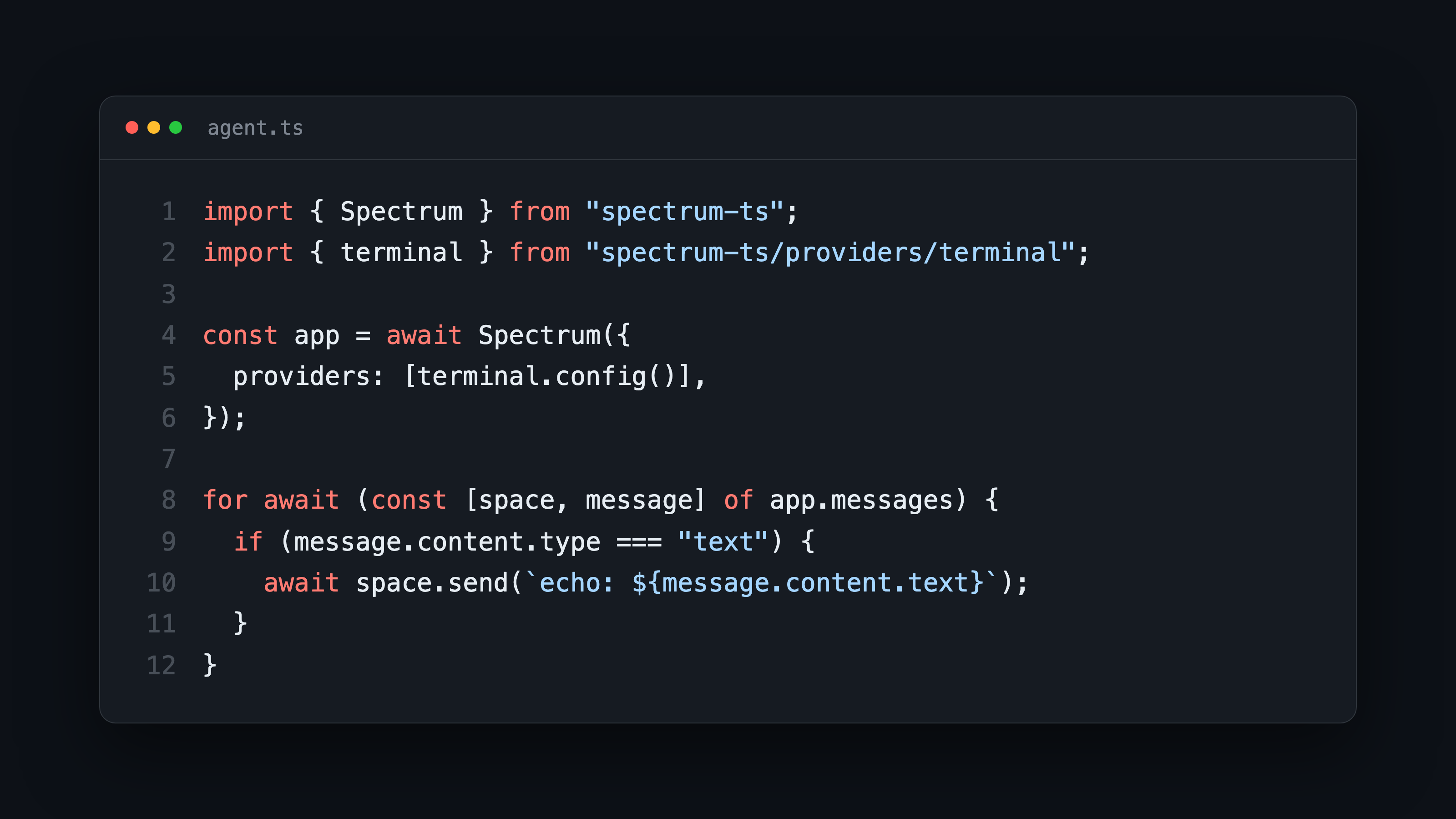
most SDKs ask you to sign up before they let you say hello world
we did it the other way around at @photonhq. the first agent you build with us needs no account at all
it is 12 lines, and it runs as a chat in your terminal. you type, your agent answers
there is no key to paste and no number to buy. you just npm install spectrum-ts and run it
when you like how it behaves, you swap one import and the same agent answers in iMessage
we are only valuable if ppl are using us, so the first try should cost you nothing
the fastest way to try an iMessage agent has no iMessage in it
run it in your terminal first. 12 lines, no account, no phone number
when it answers the way you want, change the provider to iMessage and the same code is in a blue bubble
npm install to a blue bubble, timed
Angle 2: from npm install to a blue bubble, one take, timer on screen. The time in the copy will be the measured one.
from npm install to a blue bubble in a few minutes, one take
i recorded the whole thing with a timer on screen and no cuts
the first iMessage agent on our SDK is 14 lines. here is everything i did:
- npm install spectrum-ts
- made a project and copied the id and secret
- added my own number as a user
- ran the file and texted it
the third step is the one ppl skip. on a shared line your agent only answers numbers you have added
after that it is one loop. a text comes in, the agent sends one back
you do not need a Mac sitting in a closet for any of this. @photonhq runs that part
your first iMessage agent is 14 lines of code
i know that sounds wrong. ppl expect a spare Mac, a weekend and a lot of scripts
what it takes with our SDK is a project id, a project secret and one loop that reads a message and answers it
the slow part is not the code. it is remembering to add your own number as a user before you text it
i timed the whole run, from npm install to the first reply in iMessage. it took a few minutes
ppl think an iMessage agent takes a Mac mini and a weekend
it takes 14 lines and a few minutes. i recorded it in one take with a timer
npm install, paste two keys, add your number, text it. that is the whole setup
Give your agent a brain
Angle 3: stream an LLM into the bubble with a typing indicator. The full file still has to be written and run.
an echo bot is 14 lines. an agent that thinks is one more call
the first agent everyone builds just repeats what you text it. that is fine for a test
the step that makes it feel real is small. you pass each message to a model and stream the answer back
our SDK can stream the reply into one growing bubble, so the text appears the way a person types it
and you turn on the typing indicator while the model works, so the wait reads as someone thinking
those two things matter more than which model you pick. ppl forgive a slow answer. they do not forgive silence
i will share a full example file once we have run it end to end
the typing bubble does more for your agent than a better model
ppl will wait for three dots. they will not wait for nothing
so when you wire a model into an iMessage agent, do two things before you tune any prompt
show typing as soon as the message arrives. then stream the answer into the bubble as it is written
both are built into our SDK at @photonhq. together they make a slow model feel like a person who is thinking
right after their first agent, everyone asks me how to make it smart
you add one model call and stream the answer into the bubble. then you show the typing dots while it works
the dots are the part ppl skip, and the part users notice
Make it feel like a person
Angle 4: tapbacks, typing and a contact card make an agent read as a person. Ties back to your clone story.
i once wired an AI clone of myself into my own phone number
most ppl who texted me did not realize they were talking to an agent
the writing was not what fooled them. the clone reacted to messages and sent pictures, the way a friend does
that side project is a big part of why we built Photon the way we did. the small things carry the trust
if you are building an agent ppl text, do these first:
- react to the message before you answer
- show typing while the model works
- send a contact card early so they save you
all three are in our SDK. none of them needs a better model
ppl trust a thumbs up more than a paragraph
i learned that from an agent that answered my texts for me. it reacted and sent pictures, and most ppl never noticed
so here is the cheapest way to make an agent in iMessage feel like a person:
- tapback first, so the message reads as seen
- typing dots while it thinks
- one effect, used once
we put all of these in the @photonhq SDK because the model was never the part that gave an agent away
the cheapest upgrade for any agent you text: react before you reply
a thumbs up, then the answer
it reads as "seen" and it covers the wait while the model works
it is one line in our SDK, and ppl notice it more than a smarter reply
The step everyone misses
Angle 5: why a text sits on Delivered. Add your own number as a User first. The most useful one to save.
your text says "Delivered" and your agent never answers
it is almost always one thing. you did not add your own number as a user on the project
this is the step ppl miss most when they build their first agent on @photonhq, and it is on us to say it louder
on the free and pro plans your agent sits on a shared line. a shared line only messages numbers registered as users
so before any code, open the dashboard and add yourself
if it still fails, iMessage may be sending from your email and not your number. text debug.photon.codes and it shows which handle you are using
anyone you demo to needs adding too. we should put all of this in the quickstart
the most common bug report we get is not a bug
"my message says Delivered but the agent never replies"
the cause is a missing step. on a shared line your agent only talks to numbers you have added as users, and your own is not there by default
- add your number in the dashboard
- text debug.photon.codes if it still fails
- add anyone you want to demo to
once you know a shared line only answers ppl you added, the confusing first day makes sense
the step everyone misses on their first iMessage agent:
add your own number as a user before you text it
skip it and your message sits on "Delivered" forever
on a shared line the agent only answers numbers you added. we should put that in the quickstart
Deploy it
Angle 6: one-click deploy so the agent survives a closed laptop. Time and cost will be measured in one real run.
your AI agent dies every time you close your laptop
it is the most common way a good first agent ends. it works at your desk, then you go to dinner
the agent is a long-running server. if it lives on your machine, it sleeps when your machine does
so the next step after "it works" is to put it somewhere that stays on
we keep one-click templates for Railway and Render. you click deploy, paste your project id and secret, and it is live
by our own estimate that is about 10 minutes and a few dollars a month on Render
an agent ppl text is only useful if it answers when they text. for @photonhq agents this is the step that makes it real
the difference between a demo and an agent is whether it answers at 4am
a demo runs on your laptop while you watch it. an agent runs when you are asleep
getting from one to the other takes less than ppl think. with our SDK it is a one-click template on Railway or Render
you paste two environment variables and it stays up
our estimate is about 10 minutes of work. after that the thing you built answers ppl without you
"it works on my machine" is a bad place for an agent to live
ppl text at night, on weekends, whenever. your laptop is closed for most of that
deploy it. we have one-click templates for Railway and Render, and it takes about 10 minutes
Build your own Muse
Angle 7: build a well known agent yourself in six pieces. Rides a famous name, credits the original builder.
the personal agents everyone is talking about are 6 parts and a phone number
i have seen enough of them from the inside to say that with a straight face
here is what one is made of:
- a model that decides what to say
- memory, so it knows what you told it before
- a few tools, so it can do things
- a number ppl can text
plus a personality and a place to run. that is the whole list
the part teams used to get stuck on is the number. getting an agent into the messages app you use all day was hard
that is what we work on at Photon. with our SDK the reach is 14 lines, and it is now the shortest step of the six
you can build your own personal agent and text it from iMessage
you do not have to wait for a big company to ship one, or download their app to use it
a personal agent is a model, memory, a few tools and a way to reach you. the first three you can pick yourself
the reach is where i've watched too many great agents die. they end up in a web chat nobody opens
that is the piece @photonhq handles. 14 lines and your agent is a contact in your phone
why build your own personal agent when you can download one?
because yours knows what you want it for, and it lives in your messages and not in another app
it is a model, memory, a few tools and a phone number. we make the last part easy
The full guide (article)
The whole path in one article: no-account start, first iMessage agent, the step everyone misses, deploy. Every step gets run once before it ships.
daniel_t·Articleis the iMessage agent trend a hype? maybe. but you can build one tonight and decide for yourself
a year ago, getting an AI agent to answer you in a blue bubble was a real project. you needed spare hardware, a lot of patience, and a tolerance for things breaking. most ppl who tried gave up and built a web chat
i'm Daniel, the co-founder of Photon. we build the infrastructure that connects AI agents to iMessage and other messaging apps, and our SDK is open source. the reason we started the company is that i went through that pain myself, trying to get a side project into my own messages
by the end of this guide you will have an agent that answers your texts, you will know the one step that breaks it for almost everyone, and you will know the rules that keep it working. you need to know a little TypeScript. you do not need a Mac
step 0. try it with no account
you do not need a number, a key or a signup to start. our SDK is called spectrum-ts, and it can run your agent as a chat in your own terminal. start there
npm install spectrum-ts
then make a file with this in it:
import { Spectrum } from "spectrum-ts";
import { terminal } from "spectrum-ts/providers/terminal";

const app = await Spectrum({
  providers: [terminal.config()],
});

for await (const [space, message] of app.messages) {
  if (message.content.type === "text") {
    await space.send(`echo: ${message.content.text}`);
  }
}
run it, type something, and it echoes you back. that is 12 lines
it looks like a toy, but you have just learned the whole SDK. there are four words to know. a provider is a channel, like iMessage or your terminal. a space is a conversation. a message is what came in. and your code is one loop that reads each message and answers through the space it came from
everything else in this guide is that same loop with more inside it
step 1. move it to iMessage
now make it real. create a project in the Photon dashboard, and copy the project id and the project secret. then change the provider from terminal to iMessage:
import { Spectrum } from "spectrum-ts";
import { imessage } from "spectrum-ts/providers/imessage";

const app = await Spectrum({
  projectId: "your-project-id",
  projectSecret: "your-project-secret",
  providers: [
    imessage.config(),
  ],
});

for await (const [space, message] of app.messages) {
  if (message.content.type === "text") {
    await space.send("hello world");
  }
}
look at how little changed. the loop is the same. only the provider is different, and the agent now replies "hello world" to any text it gets
before you text it, read the next step. it is the reason i wrote this guide
step 2. the step everyone misses
add your own phone number as a user on your project before you send anything
here is why. on the free and pro plans your agent runs on a shared line, and a shared line is only allowed to message ppl who are registered as users of your project. that rule stops anyone from using a shared number to text strangers. but it also applies to you
if you skip this, you will text your agent, your message will say "Delivered", and nothing will come back. the send gets rejected with an error that says the target is not allowed for the project. i have watched very good engineers lose an hour to this, checking code that was fine the whole time
so open the dashboard, add your number as a user, and text the agent again
if it still fails, your phone may be sending iMessages from your email address and not your number. text debug.photon.codes and it will tell you which handle you are using. add that one
step 3. give it a brain
an echo is not an agent. the next step is to put a model between the message coming in and the reply going out
i am not going to paste code for this part, because the right code depends on which model you use and we are still writing a full example. but the shape is the same for Claude, GPT or anything else:
- take the text out of the incoming message
- turn on the typing indicator, so the person sees the three dots
- send the text to your model, along with a short description of who your agent is and how it should talk
- stream the answer back into the conversation, so the bubble grows as the model writes
our SDK supports both the typing indicator and streaming a model's answer into the bubble. use both. a reply that appears after a few seconds of nothing feels broken, and the same reply after a few seconds of typing dots feels like someone thinking
keep the instructions to your model short at first. tell it to answer like a text message, in a sentence or two. long replies are the fastest way to make an agent feel like a bot
step 4. make it feel like a person
before Photon i built a clone of myself and connected it to my own number. most ppl who texted me did not realize they were talking to an agent. the writing was average. what made it work is that it reacted to messages and sent pictures, like a person does
iMessage has a set of small behaviors that ppl use with each other all day, and your agent can use them too:
- a tapback on the message before the real answer arrives
- the typing indicator while it works
- a contact card early on, so ppl save your agent with a name and a photo
- a message effect once, for a moment that earns it
add the tapback first. it takes very little work and changes how the whole conversation feels. one note: some of the richer features depend on which plan you are on, so check the docs before you design around them
step 5. deploy it
right now your agent dies when you close your laptop. an agent is only useful if it is there when someone texts it, so move it to a server
there are one-click templates for Railway and Render. you pick one, add your project id and secret as environment variables, and your agent runs somewhere that stays awake. our own estimate is about 10 minutes of work and a few dollars a month on Render
then test it properly. close your laptop and text it. text it again tomorrow morning
the rules that keep your line alive
these come from running a lot of agents, and every one exists because someone learned it the hard way:
- let the user text you first. do not start conversations with ppl who did not ask
- keep your first message simple. no links and no media in it
- do not use iMessage for cold outreach. that belongs on other channels
- remember that a shared line only talks to ppl you added as users. when you demo to a friend, add their number first
iMessage is where ppl talk to the ppl closest to them. agents that respect that get to stay
what to build next
you now have the full path: a loop, a number, a brain, some manners and a server. from here it depends on what your agent is for
a few directions ppl take it:
- give it memory, so it knows what you said last week
- give it tools, so it can do things and not only talk
- put it in a group chat with you and your friends
- run the same agent on other messaging apps by adding another provider to the same list
my advice is to pick one job and make the agent very good at it before you add anything. the agents that ppl keep texting are the ones that do one thing well, in the place where they already are
if you build something with this, send it to me. i read all of them